
Among the other things about which the tour operators cautioned lowered expectations, was the ease of crossing the Southern Ocean, a notoriously challenging passage famous for foul weather and high seas. The 1000 kilometers between Argentina and the Antarctic Peninsula is known as the Drake Passage. We had heard rumors of the tour that had immediately preceded us: the wind and waves were so extreme that they had to abandon their planned route to Antarctica and instead travel to the Falkland Islands. Their tour featured many Antarctic-like things, including Emperor Penguins (which we would not encounter), but it was not Antarctica. And I don’t think anyone’s travel insurance would cover that distinction.
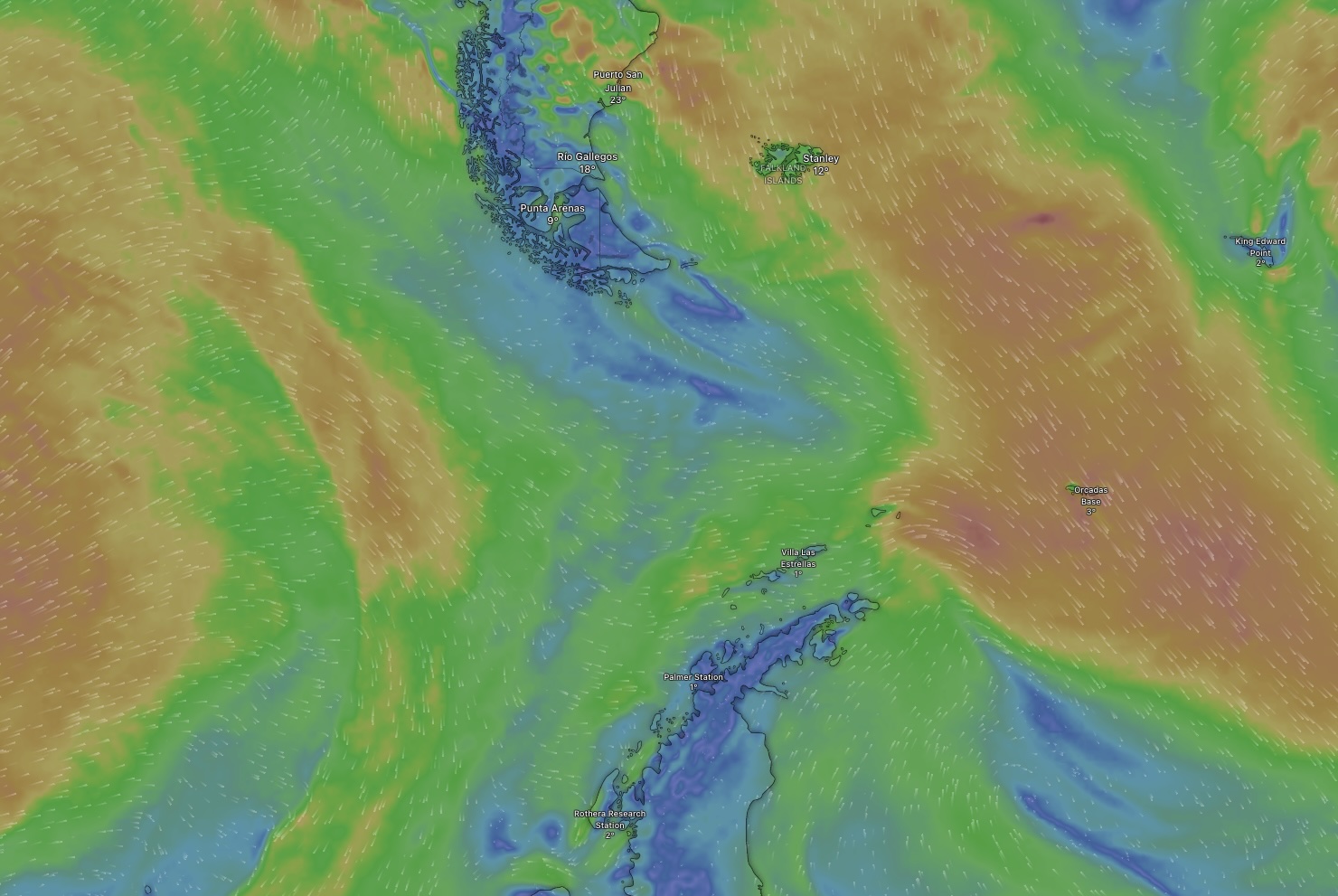
We were advised daily on the wind and wave outlook and had the great good luck of mild conditions. Here is a screen shot of a prediction. The blue and green areas have mild winds, but when they transition to yellows and reds, the ride will be rocky. On our trip across the Drake Passage, we saw those scary zones, but they did not cross our planned route.
We had been warned of the possibilities of rough seas, and offered advice on managing seasickness. We took it quite seriously, having suffered on an earlier, much milder tour on a Caribbean sailboat. Naive landlubbers, we were completely unprepared for the ongoing semi-random rocking motion that made unceasing demands of our inner-ear and brainstem-operated stabilizing systems. Poldi was among the most affected, spending much of her time heaving over the side rails until one of the other passengers offered a spare skin patch medication to quell the nausea.
This time she was prepared with over a month’s worth of such medication, and now she was in a position to offer her surplus to other novice seafarers.
But it was not necessary. As the wind and wave forecast was presented to the passengers assembled for our nightly updates, a cheer erupted, acknowledging the blue and green colors on the map. We applied our patches anyway, wanting to stay ahead of any change in conditions.
Because of the fair weather, the ship’s average speed was around 15 “knots”, nautical miles per hour (don’t ask). This is equivalent to 28 km/hr, so the passage should take roughly 36 hours. The tour itinerary had allocated a full 48 hours for the transit, so we were pleasantly surprised to arrive at the South Shetland Islands ahead of schedule! So much ahead that the crew prepared for a landing event on an accessible island! We would be able to set foot on land in this remote part of the planet!
Barrientos Island gave us our first exposure to this exotic place. And it was filled with penguins!
