At the train station, Poldi triggers a loud Italian discussion ranging from train schedules to politics.
We decided against driving our car to central Naples, our experiences in the suburbs and countryside were harrowing enough. We took the train, hiking to the next town, Torre del Greco, to the train station. We purchased tickets and found ourselves on a platform on one side of the tracks. My sense of east-west was that we should be on the other, so I asked Poldi how she knew which was the one we should be on.
The station markings were inadequate, so she approached a man to ask if this was the right platform to go to Naples. It was a simple question, yes or no, but he gave a lengthy answer (in Italian of course, which I did not understand).
Entry to the park, and the trail to the top, involves an elaborate set of online transactions. It took 30 minutes, and repeated appeals to the park staff for help, to navigate and procure the right credentials. These guys probably had it in minutes.
On learning that Vesuvius is overdue for its next eruption, we decided to go visit the famous volcano. Who knows, it may be only weeks before it next erupts!
Getting to Vesuvius is a multi-step process. You drive to a “parking area” (which is really one lane of a two lane road allocated to parking) at 800m elevation. You pay for the parking.
Then you pay for a shuttle to take you to a foot trail entrance gate at 1000m.
Then it becomes challenging. Entry is by pre-sold tickets available online only. This is a popular trail in a national park, and the park limits the number of hikers on the trail. The tickets are sold out weeks in advance, but there is a “last minute” ticket mechanism, limited by the number of people on the trail at the moment. They release ten tickets every half-hour or so, and to get one you must request, be approved, and purchase them on-site.
But there is no ticket agent at the gate to do this. It is done online only. We are near the summit of the volcano in a mountain wilderness area with limited cell phone connections and we need to go online somehow to do this.
Recognizing this situation, the park set up a local wifi. There is a poster at the entry gate (in Italian) that helps to connect to it. Fortunately, I have my personal translator available. This is the beginning of a lengthy process that included the following steps, nearly all of which required entering and re-entering your name, address, and email:
Register to gain wifi access.
Register to the national park system. After doing so, confirm by responding to the email they send.
Register to the ticket vendor. This is a separate third party from the national parks. Create a password and respond to another email to confirm.
Register for tickets. Request a date and time. This page was very confusing; it was unclear how to do this.
Provide payment- credit card credentials.
Tickets are then issued. But the web page does not display them. Some other web page or background email contained links to them.
We needed assistance three or four times to get through these gauntlets, with Poldi speaking Italian with the park entry attendants and playing the “we’re old and don’t understand” card.
Eventually, we got it, and the ticket image with its barcode appeared on my phone, but then, presenting it at the gate turnstile, with its scanner, I could not place the phone in the correct position. Once again, the attendant had to hold my phone in the right spot for me. Sometimes it’s embarrassing to be a retired computer pioneer.
Our rented Fiat 500. I could fit in ok, but could not drive it.
On narrow European streets, smaller is better, so Poldi rented a Fiat 500 for our visit to Naples. She paid extra so that we could both be drivers. I was pleased that the seat could accommodate my long legs, and I looked forward to driving a manual transmission again. Normally, I drive, she navigates, but as I attempted to pull out of the rental car lot, it became apparent that something was wrong. I could not feather the clutch, and hitting the brake pedal caused the engine to rev. My feet were too big to fit in the well, and my shoes were interfering with the side wall and the other pedals. I could not drive this car!
Poldi came to the rescue. Her dainty size-9 feet were compatible with the assumptions made by Fiat’s engineers, and she was able to drive to our accommodations. I don’t measure up to her navigator skills, so I’m wondering if maybe all I need is a pair of fine Italian shoes to drive this car.
Driving the city streets in Italian traffic is harrowing. Poldi is still getting accustomed to the Fiat’s clutch and gearbox, and I am on my learning curve as a navigator. I am constantly annoyed at the “forward is up” dynamic orientation used by Apple Maps on my phone GPS display (why can’t I just set a preference for “north is up?”). Somehow, we got through the Napoli traffic without incident, despite the best efforts of motorcycles weaving around cars and pedestrians. I don’t see why there aren’t more collisions.
When we get past the city traffic and narrow winding streets, the roads remain narrow and winding, and in mountainous terrain sometimes with curves so tight they place large mirrors to provide a glimpse of approaching cars, uphill or downhill.
We marvel at the busses that require both lanes to make the turn. Poldi encountered one. The bus stopped. Poldi stopped. It was up to her to reverse and go up the road she was descending to provide clearance for the bus. Unfortunately, the car slipped out of gear as she tried. After several such false efforts and repeated slips, she had finally backed up enough for the bus to pass.
This album includes a photo of the little Fiat, and some pictures of the funky hostel where we stayed for a week. It was as you might envision: young people finding the most economical way to travel through foreign lands, engaging with each other as they prepare meals in the communal kitchen and philosophising over beer at night. We were the old hippies in the group, enjoying the virtual trip back to the sixties.
At the top of a mountain pass where the wind was strongest, they powered millstones for grinding wheat.
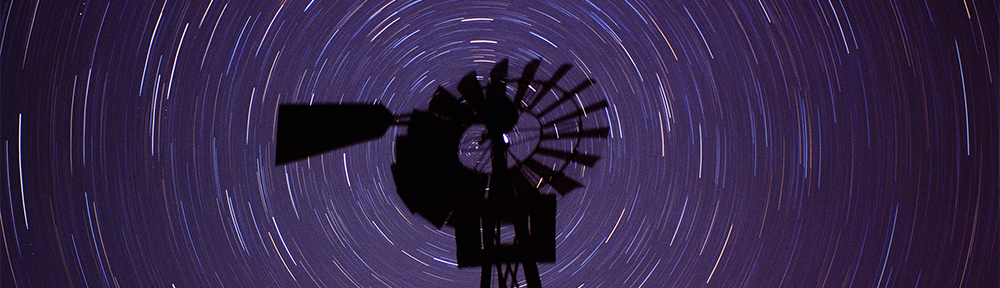
In the history of humans before engines and motors, which is pretty much all of civilization, everything had to be done by muscle, either human or animal, with the exception of a few locations where wind and water energy could be harnessed. On Crete, in the fertile lands of the Lasithi Plateau, windmills were built to power millstones for grinding grain, and to pump water into irrigation canals (which of course were dug by hand).
We saw the remnants of old windmills, stone structures built where the wind was strongest, and windmills in fields, most of them no longer working, replaced by motor-driven pumps when electric power became available.
Our travels take us to another beach, Elafonisi, famous for its pink sand beaches. It is very popular and we spent another afternoon in the sun. There is no pink sand however, except for a small patch we discovered at the far side of the lagoon.
It is my suspicion that the famous labyrinth at the Palace of Knossos (which held the Minotaur), was really just an adjective applied to the whole complex. Here is a reconstruction of it. What do you think?
As a young grade school student who had recently learned to read, I felt like the world had just opened up to me. There was so much to know, and now that I could read books, it was all accessible. I had a tightly specified and enforced bedtime, but my parents allowed a loophole around that rule: I could stay up for a half-hour beyond, but only if I was reading.
I consumed many books during this grace period, and among my favorites were stories of ancient Greek and Roman mythology. At one time I could recite the Greek gods, their Roman equivalents, and knew their histories and backgrounds. I knew the important venues for the stories as well: the Oracle of Delphi, Hercules and the Augean stables, and the Labyrinth of Knossos, where the Minotaur was held captive.
This is my knowledge of Crete as we arrived: this is where the Minotaur lived! And where Theseus ultimately slew it.
We visited the excavated remnants of the palace of Knossos. It was a dominating center of influence for centuries, but after millennia, it is now rubble. Archeologists have recovered amazing artifacts from it and other influential sites, which are beautifully displayed in the Archaeological Museum in Heraklion. Check out the photos contained in this album.
After visiting the museum, we took a day trip to Matala, a beautiful seaside town in the south of Crete. It had been discovered in the 60s by popular musicians, who would come here to escape their lives of celebrity, and do the things that rock and roll musicians liked to do. Which also included writing music. This is the place where Joni Mitchell crafted much of her famous “Blue” album, and she is still celebrated and honored. The hippie vibe still lives here.
We had no intent of spending an entire afternoon at the beach, but that is what happened. We can see why this place is so appealing. You can see a few photos in this album as well.
Poldi with Italian sisters Cetta, Rossella, and Cetta’s husband Carlo on a hike through the town of Macugnaga in the northern Italian Alps.
I’ve had the pleasure of touring Italy twice before, each time accompanied by my partner, now wife, Poldi, as guide and translator. She lived there, acquired the language, and acquired a host family during her time as an AFS exchange student. She returned every few years to keep her connections strong.
With COVID, our plans to visit were cancelled. And the years since have been filled with other events, so it was almost a matter of urgency as Poldi made travel plans to visit this year. And as long as we are there, why not make up for the lost trip to see Pompeii?
Here is a collection of photos of Poldi’s Italian home, her Italian sisters, and our outings in this northern area that includes the Italian Alps. Other albums contain the trip to Naples and Pompeii.
I had been to New York City a few times in my life. Each was somewhat accidental: a business trip, a delivery of childhood possessions to children who had grown, and a trip to witness a career accomplishment (a film festival screening) of one of them. Each had a primary purpose, and there was inadequate time to explore the vast experiences that New York City offers. I was not able to be a sightseeing tourist.
This occasion was different. There was no preset agenda or itinerary; we were taking the opportunity to spend a few days with Poldi’s son Shal’s family living in Brooklyn before beginning our travels to Europe. Poldi asked me if there was anything I’d like to do while we were visiting.
Well, I was always curious about the structure and construction of the world’s tallest sculpture (for a hundred years), the Statue of Liberty. Could I climb the spiral staircase inside?
Despite having lived in New York since attending film school twenty years ago, Shal had never visited the famous landmark. This sounded like a great outing to him. Since there were tourist ferries every twenty minutes to it, we could just show up at the dock and tag along.
It turns out that it is not as simple as catching a subway train, and we had to pre-register for a position on the ferry. Security checks were involved before boarding. And if you wanted to go on the tour of its interior, sign up a month ahead. I would not get in this trip (probably for the better, based on the claustrophobia I might suffer).
It was a wonderful experience. Liberty Island is as beautiful as the sculpture it hosts. I have pictures of it in this album of our New York City segment of this trip.
This punch card identifies the parts of a Fortran statement. The first five columns contain the line number, unless column 1 is a “C”, which turns the statement into a comment. Column 6, if marked, usually by an “X”, turns it into an extension of the previous statement. Columns 7-72 hold the Fortran statement itself, and the rest are an optional “sequence field” for use by the programmer as desired.
I wrote my first program at the age of 15 using a coding pad provided by my dad, who was managing an early computer installation for his employer, General Mills. It was 1968, and programs were drafted on these pads, which were basically a grid with 80 columns and maybe two dozen lines. The program statements on the pad would later be transcribed by a keypunch operator onto punch cards, one line per card, and then fed to the computer by a card reader that could sense the holes in the cards and turn them into bits in the computer’s memory.
I didn’t understand the details of how computers worked, but I was able to figure out how to write a series of statements in a programming language (Fortran) to do something I thought was cool: print out the coordinates that I could plot on graph paper (yes, that’s how it was done), to create an Archimedes Spiral; the path traced out by what I imagined to be an insect crawling on a ruler that was rotating around the starting point.
It was an ambitious goal, and I had to think hard about how to do it. I had to learn about loops, conditional IF statements, and distinguish between integers and floating-point numbers. And how to format them and print them out. In the end, I think I was able to do it on one page. I carefully wrote each line on the coding pad and gave it to my dad, who promised to take it to work and run it on the computer (I later learned it was an early Control Data Cyber 6600 model which occupied a large room).
He returned that evening with the result, a line printer output on “computer paper”, large folded pages with detachable tractor feed sprocket edges. I looked at it and saw numbers printed along the left edge. Pairs of numbers, one pair per line on the page. These were the XY Cartesian coordinates I was looking for!
I pulled out my pages of graph paper and started plotting them. I marked a dot at each XY location, and soon I saw that as I connected the dots, a spiral shape was forming! I was quite excited. This was the experience I had of writing my first program.
I later learned that writing a program that ran correctly on the first attempt is a rare thing. And I also heard that my dad teased his staff of professional programmers to try and be as successful as his teenage son.
In 1974, my roommate and classmate Jeff Harvey came home in a highly excited state. He had just purchased the recently published book, “Gravitation”. It was unusual for a reference or textbook —not just because it was a paperback, but also because it was immense. It had large pages and it had a lot of them: over a thousand. And each seemed to have sidebars, notes, and explanatory boxes or illustrations to augment the text, which itself was written in a distinctly non-textbookish, conversational style.
We had both taken courses in special relativity, but general relativity, which explains gravity, was an advanced topic. And Jeff was eager to dive into it. He set himself a goal of digesting some portion of this massive book every day.
The authors of the book were unknown to me at the time but they would become familiar names as I continued my physics education. Charles Misner, Kip Thorne, and John Wheeler, were collectively referred to as “MTW”, which became the moniker to brand this monumental work.
Misner and Thorne were students of legendary physicist John Archibald Wheeler. Wheeler’s distinctive style can be inferred from his coining of popular words and expressions such as “black hole,” “quantum foam,” “wormhole,” and “it from bit” (existence from information).
Misner had a distinguished career in general relativity and cosmology, and Thorne, in addition to popularizing black holes and time warps, spearheaded the effort to build gravitational wave detectors, LIGO, for which he received the Nobel Prize in physics in 2017.
I have encountered these names off and on over the years as my interests have followed the remarkable science yielded by space telescopes, particle accelerators, and gravity wave detectors. I marvel at the things we have learned in my lifetime.
My career was initiated and informed by my study of physics, but veered in other directions. My roommate Jeff, on the other hand, completed his goal of reading and understanding the book Gravitation, and went on to become a noted physicist in his own right, making contributions to string theory and teaching relativity to the next generations of physics students at the University of Chicago.
I was motivated to describe this old memory of Jeff’s enthusiasm for a textbook because Kip Thorne will be the featured speaker at the Misel Family Lecture at the University of Minnesota later this month. I will be thrilled to hear from one of my physics heroes as he describes the fascinating things he has explored in his career.
Had I had Jeff’s fortitude to digest Gravitation, perhaps I would not remain puzzled over the twins paradox. Even now, it seems I just keep mulling it over, and making this post caused me to add some more to my commentary. Well, since the book is still in publication, maybe it is not too late!
Hiking through the desert in the morning after an overnight photo session.
“Can I still do it?” and “Will I still enjoy it?”
I find myself asking these two questions about various activities I undertake. Now maybe you are thinking I am making oblique references to sex, but so far, that hasn’t been in the category of activities I am questioning.
I noticed that, after turning 70, my superpowers appeared to be diminishing. This was a surprise to me because so far, at every decade mark, I had felt little difference from the previous one. There were a few things I suppose– certainly my appearance has changed as I have grayed, but for the most part, my capabilities have held.
Until now. I am starting to notice that my flexibility is less; I am stiff in the morning; my strength and stamina are diminished. Something has happened to the sinew and grit that powered my younger self. The analogy I entertain is: “the rubber bands are drying out”.
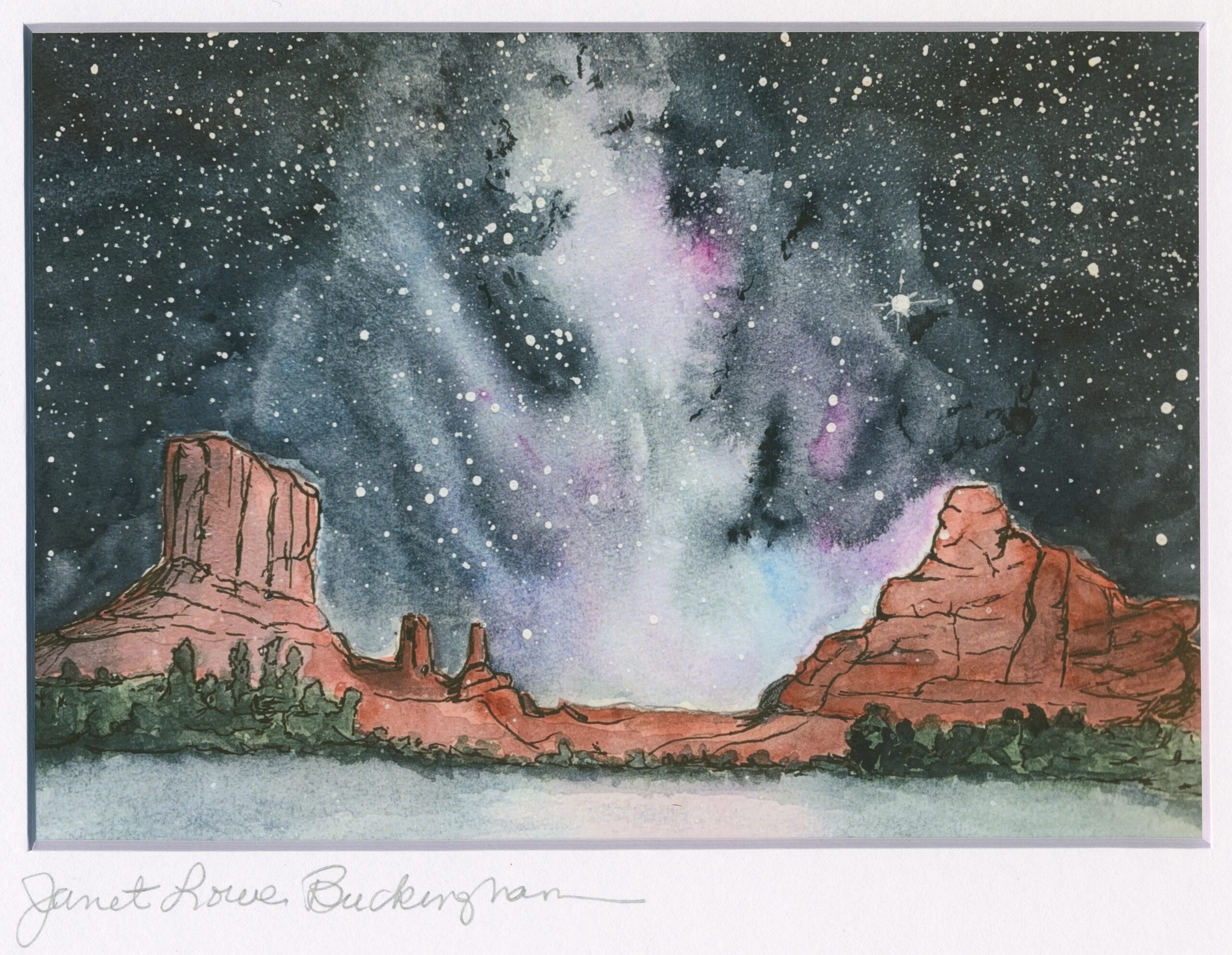
My limitations became apparent in a recent outing to take pictures of the night sky, an activity I have enjoyed for decades. One of my life highlights was recording pictures of the night sky on Racetrack Playa in Death Valley a few years ago. Currently, it is a similar trip with a hike to a collection of geologic features in the badlands of New Mexico. I treated it like many others I had undertaken, but this time, things felt different.
During my “Nightscape Odyssey” in 2001, I would survey a candidate night sky site during the day, making notes of how to get there, what compositions were promising, and generally getting familiar with the area. I would then return to the site later, as twilight approached, or sometimes even in the dark, and set up my telescopes and cameras. It made for a long day, and a long night, and I was usually exhausted the next morning. Nevertheless, after a morning nap, I would start the process all over again for the next night’s session.
This time, I was prematurely worn down after the initial reconnaissance and had to postpone the nighttime excursion until the next day. I didn’t expect that. Maybe it was the heat, or maybe it was the elevation, but those were factors before, and back then I still had the energy to carry on.
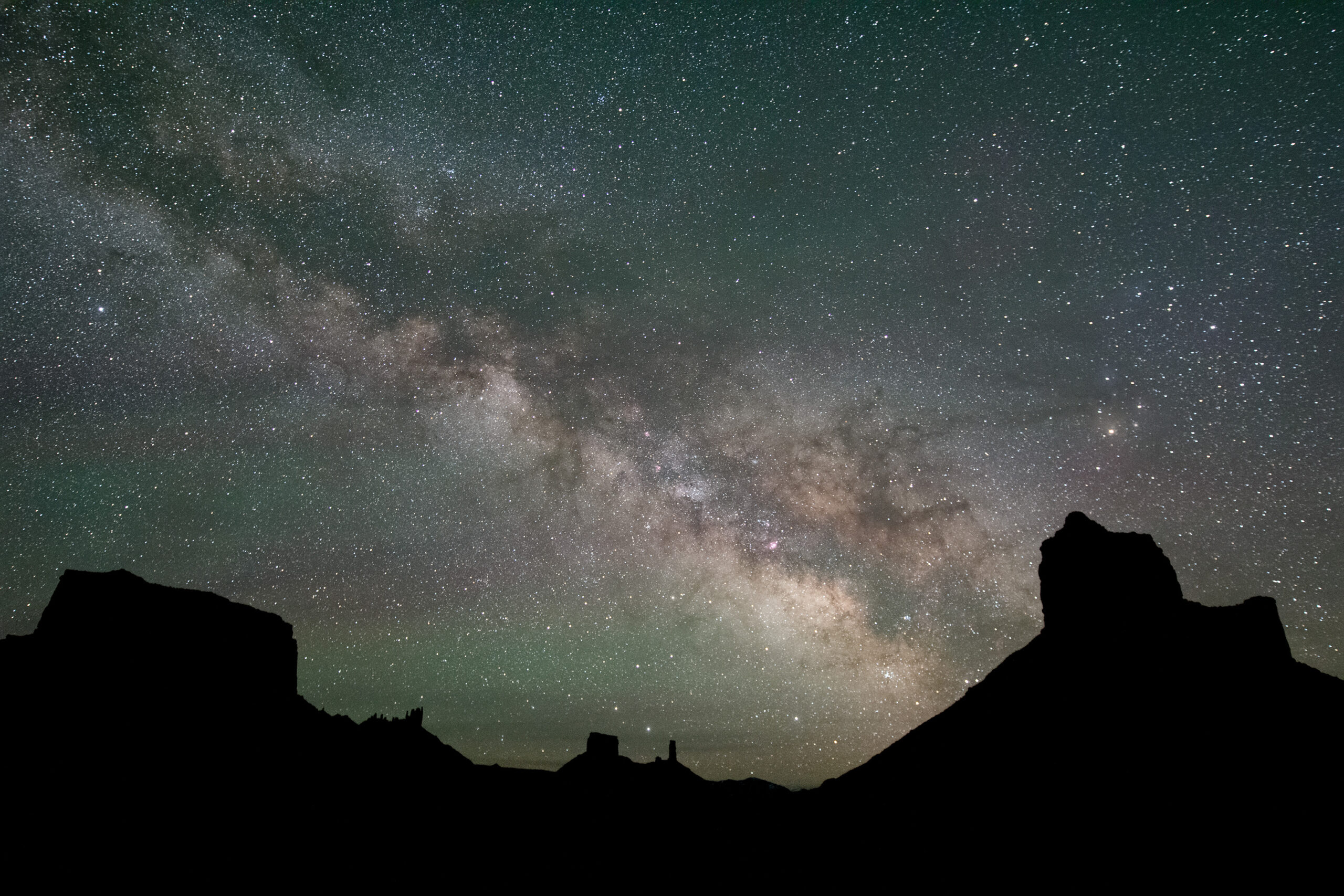
The lure of an image in your mind’s eye is a strong motivation, and I was very excited to see if I could capture the Milky Way behind the Alien Throne, my target for this outing. I described the overall experience previously, but I will now describe some of my other reactions as I undertook it.
I mentioned that my backpack was heavier than I expected. Yes, it had an excess of camera gear, but that was the payload. The rest was support: water, snacks, and protection against the desert night. The total came close to forty pounds, a typical number for a much longer trip. It was well within the range of packs I had carried before, and tonight I only had to go 1-1/2 miles over relatively flat terrain. I put it on, cinched the hip belt, and felt the familiar shift of my center of gravity as I took the first steps down the trail. It felt good to be doing this again.
As I continued, I noticed that I could feel the load in my legs. This was not a daypack. I could also sense some strain on my knees. This reminded me of an incident that happened a previous time I had carried this pack.
It was fifteen years ago. I had been on a weeklong backpacking trip, and on the last day, while climbing a ridge along the Lake Superior Hiking Trail, I experienced a sudden collapse of my right knee. It was truly a surprise; I fell to the ground. It wasn’t painful, my leg was just uselessly limp. My hiking buddies helped me back to my feet, but I couldn’t sustain the weight of the pack and collapsed again. Fortunately, it was only a short distance to our destination, and by distributing most of my load to the others, we were able to get there.
But here I was, hiking solo in a wilderness area as night approached. If the same thing happened, what would I do? I was a mile from my car, but to get there, I would have to abandon my load: $5000 of camera gear. Well, I guess I should factor that into my choice to embark on these excursions!
I carried on. And I carried the hiking poles that Poldi had lent me. I had always considered them a nuisance, getting in the way of my path and interfering with handling a camera, but I was now starting to appreciate them. They bore my weight and guided my traverse across the ruts and ridges in this rugged landscape. What was once an annoyance has now become a dependence.
I made it to the Valley of Dreams, following the route I had traveled the previous day, but the Alien Throne was another half mile through uncharted ridges and eroded gullies. I could see the destination on my GPS, but the terrain was not adequately shown. I found myself blocked by box canyons and cliffs. My strength was waning, the sun was setting, and I wondered how many more of these obstacles I could clamber over. If I became stuck, I would just make the best of things, taking pictures of whatever features were around me, even if they weren’t my prime target. It could still be a wonderful evening.
I was getting close, but a sudden drop-off was in the way. It was too high to scramble down, especially bearing my pack. So I removed the pack, lowered it over the edge, and then eased myself over and dropped down onto it. This was the last obstacle. I rounded the corner and found the Alien Throne! But it was not lost on me that this was an obstacle that in earlier days would not have presented a challenge. Further, had I not had a semi-graceful landing on my pack, what injuries would I have sustained?
It was a small barrier, but I was stranded on the shelf 5-feet above the valley floor I needed to get to. I dropped the pack and eased myself over the edge onto it.
I filed those thoughts away as I looked over the theater containing the Alien Throne. I needed some time to recover my breath after the stress and strain of navigating these eroded features, but I was aware that the light was rapidly changing. I needed to get my cameras set up.
This is a very pleasurable part of the adventure. I am finally at the site and can look for the compositions I have imagined. It is a mix of guidance and guesswork. I have some tools to help with orientation and timing, but it really takes placing an eye to the eyepiece to see how the landscape fits the sky. There are technical issues to resolve as well: exposure times, lens apertures, focus, and shutter intervals. These keep me narrowly focused on my goals and shut out any other concerns (I’m oblivious of the need to worry about scorpions).
But as I placed each camera and tripod in its place, I could not help but notice each difficult position, and each awkward angle I had to assume in doing so. Yes, the terrain is uneven, and the viewpoint requires the right height and angle, whatever it needs to be for the composition, but I don’t remember it being such a physical strain to achieve it.
Kneeling is a particular motion, required for just about any adjustment. I find that it is hard to get back up. And when I drop something, it becomes a major project to recover it. The aches and pains of drying rubber bands were making themselves known in this otherwise pleasurable setting.
But when the cameras are each in place and running, I heave a sigh and settle in for a night of watching the heavens flow across the sky. It will be an hour or more before the cameras need attention. This is another pleasant part of the nightscape adventure. I record the photographic details of my experiments in a notebook and contemplate what the outcomes might be, and what subsequent exposure tests I should undertake. When I am with Poldi, we find spiritual and intimate activities to fill the time under the stars, but on this night I am alone, at least for a while. Soon after my cameras were set up, another night sky photographer arrives. We share our stories while the stars move above us.
We eventually retreat to our refuge against the cold desert night. I am in a sleeping bag tucked into a recess in the rocks. I relax here, watching the sky above and listening. There is a cricket chirping. I am astounded at how loud it is, and then I remember, I now have “bionic ears,” recently acquired hearing aids, another indicator of crossing the seven-decade threshold. They have been tuned to amplify the high frequencies that I was previously missing. This helps me to understand the speech of women and children, but it really helps me to notice the frequency of cricket chirps, which are slowing as the temperature drops. The chirps keep me awake.
But eventually they stop, or maybe I drift off. When my alarm goes off for the next exposure event, I climb out of the sleeping bag and stumble toward the camera that needs attention. The moon has set, and it is now purely starlight that guides me. Plus my flashlight, because starlight is just not enough, at least on this uneven terrain. As I navigate over the rocks toward the camera, I recognize the precariousness of my path. At home, at night, in the dark, I must sometimes navigate to the bathroom. It is much easier with a nightlight– so we have installed them. Here, in the certified dark sky wilderness of New Mexico, I am on my own. I am aware and notice the uncertainty of my steps on the sandstone terrain. Loose gravel and vegetation contribute to the hazard. Once again, I recognized that if I fell and was injured on one of these camera servicing missions, I would no longer be enjoying the night.
But the cameras, with their new exposure settings and refreshed batteries, continue their nighttime schedule. I return to my nook to marvel at the Milky Way, now high in the sky. The cricket reminded me that I have bionic ears, but the sky reminds me that I also have enhanced eyesight.
The miracles of modern optics can correct for obscure vision conditions, including astigmatism and other aberrations. I put on my progressive prescription glasses so that I could appreciate the full glory of the night sky, beyond my now compromised seventy-year-old built-in lenses. It was a bust. For whatever reason, my glasses made the view worse, not better. I will be investigating this failure, but in the meantime, I enjoyed the night sky without optical assistance.
The pleasures of the night continued; the cameras were serviced despite the risks, and eventually the sky began to lighten. Dawn was approaching.
The exposure schedule ended as the sun rose, and I gathered my equipment, preparing for the hike back. The night before, I had reached my destination just before my strength ran out. Now, after a night to recover, I expected an easy hike. I knew the way. And it started that way, but soon became hard.
It was not a difficult trail, mostly level. And the sun was still low, the temperature moderate. The path was easy, but on encountering the slight banks in and out of a dry creek wash, I was annoyed that I could not just scramble them; I had to take carefully placed steps.
Only a mile and a half back to my car. Yet, I found my feet becoming “heavy”, without the lift to rise ever slightly for the next step. And they were sloppily planted in that next step. It was the closest thing to a stagger, and I realized it.
So I paused for a rest, dropping my pack for a while. Sitting on a rock and taking some water, one of my hiking poles fell to the ground. I cursed. Now I would have to bend over to get it. When did just stooping down become such a pain? I have never enjoyed getting under the desk to plug in computer or power cables, but just bending over to pick up something I dropped? That’s new.
Reaching the point of involuntarily dragging my feet was a new experience, a physical regime I was unfamiliar with. It made me appreciate the limits that people sometimes overcome, not just for recreation, but for survival.
And it added to my list of items to balance against the pleasures of my remote outings. I really enjoyed the hours in the desert monitoring cameras and watching the galaxy cross the sky. But I have become aware of the risks I am taking on, some of which seem to have increased over my years.
I was halfway back. I was aware of the remaining distance, which was more than the physical distance. It included the depletion of my energy reserves. I may have been staggering, but I was not to the point of stopping. I hoisted the pack and continued back to the car.
I can now declare that “I can still do it”, and I will also declare that “I still enjoy it”, but I must temper this last statement by acknowledging that the enjoyment is diminished by the increased risks I take on.
Life is filled with tradeoffs.
It may seem that I am complaining about getting old, and I guess I am, but I am also thrilled that I am still around to do so.
My motivation, an image in my mind’s eye becomes real (click for full resolution).If I look back a little, I might be able to extrapolate how this next decade will go. So far so good. I hope I can be as spry as Dick Van Dyke when I get there!