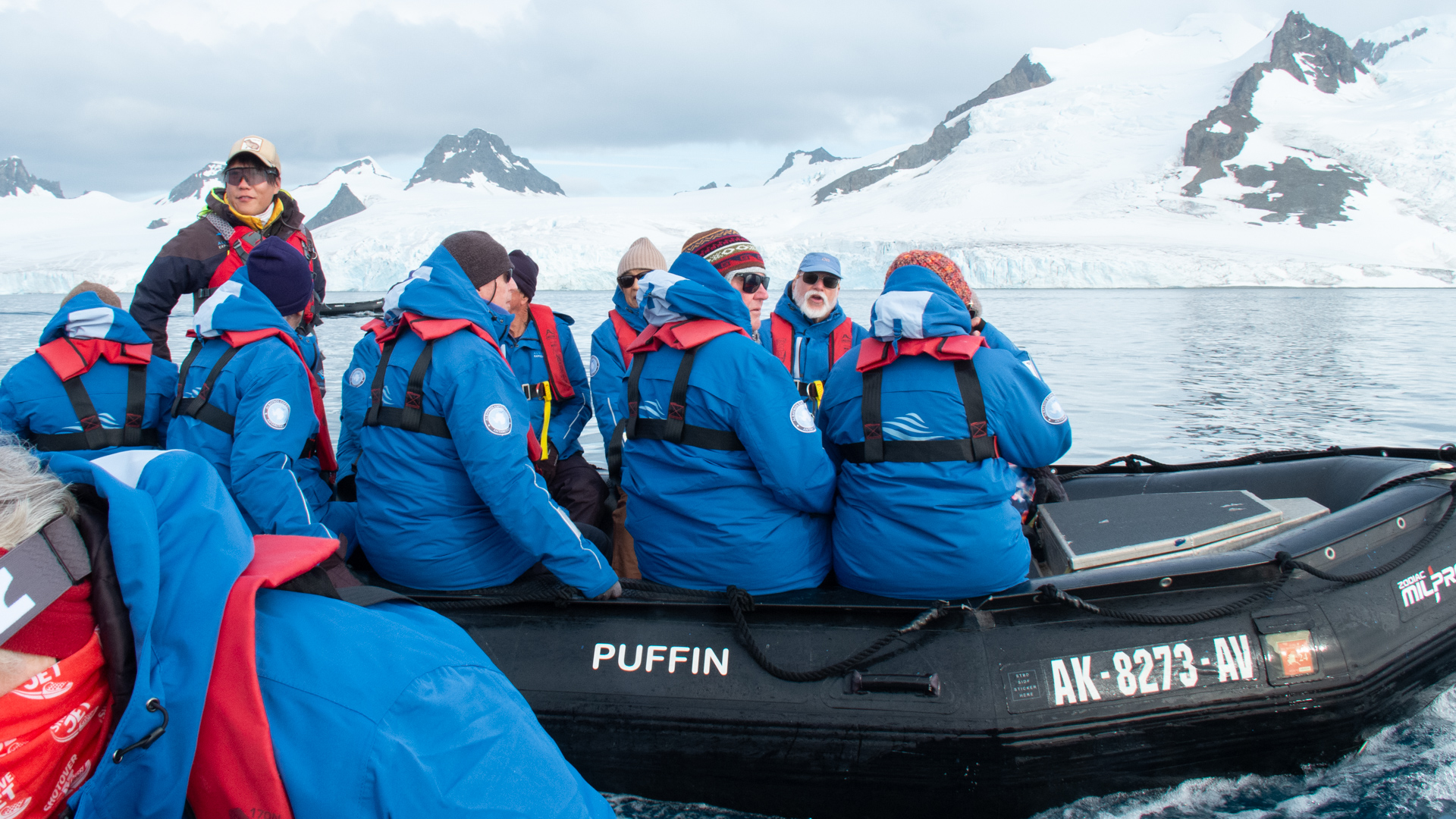
“Zodiac” is a trade name for the small boats made by the original manufacturer, Zodiac Nautic, but it has become a generic reference for inflatable boats of this type. Ocean Victory has a corral of twenty such boats (from Zodiac-Milpro, the military/professional division of the company).
The management of passengers onto and off of these crafts is no small matter. We were given detailed training instructions on how to step into and off of them from the “mudroom” deck only a few feet above sea level. We were taught the “seaman’s grasp”, a double handlock with the crewperson assisting us on and off the Zodiac. There were strict rules about how and where to sit on the rubber pontoons. No standing without permission.
As a result of the protocols and training, the Zodiac safety record for Ocean Victory is unblemished. I expected that in all the history of transporting thousands of tourists over many years, some passenger would have exhibited poor judgment, or poor discipline, and fallen overboard– we were instructed on what to do if this happened, as if it might. But remarkably, it never has.
Deploying Zodiacs, whose passenger capacity is 10, maybe 11 plus pilot, for a tourist outing of 160+ passengers is a mighty logistical challenge. The Zodiac boats are held in a section at the stern and two cranes lift them up, out, and down to the water, where a crewperson would detach, then motor off to either provide advance shore support for a landing, or to collect the next group of ten passengers to take them on an excursion, either on a cruise exploring the bay, or to a “wet landing” where we could hike around and explore the terrain.
There are restrictions on the number of tourists allowed on land at one time. This is to reduce the tourism impact and footprint on this wilderness. It also improves our tourist experience. Being among four Zodiacs on land at any one time (forty people), is much nicer than being in a crowd of 160.
The impact on the environment was also considered as we prepared for our landings. We washed our boots in disinfectant before boarding the Zodiac, to prevent germs from infecting penguin colonies and anything else. We also cleansed our boots on return, to protect us from whatever penguin germs we might have encountered.
On the Zodiac, it is exhilarating. We are within touch of the ocean, and at the level of its wildlife: birds, whales, seals, and of course, penguins. Ice surrounds us, as icebergs, ice floes, and sometimes as a slurry of randomly shaped ice chunks.
There is much to see, all around us. But unfortunately, the action is either behind me, which makes it difficult to pivot and aim my camera, or it is behind the passengers on the other side of the Zodiac, in which case they obscure my view. No one gets a good shot.
Landings are significant. They don’t happen unless conditions are safe. And the transition from Zodiac to land requires some instruction and finesse. Your boots and outerwear WILL get wet. But the crew knows exactly how to assist us onto shore. I note the large containers of unidentified gear positioned up shore, delivered by the advance crew before any passenger set foot here. I assume it is for emergencies, and I am impressed at the protocol being displayed here for our safety. We are tourists in a place that has higher risks than most tourist destinations. I’m glad to be taken care of.
We actually encountered one of the few risks to Zodiac boats, the Leopard Seal. This is an “apex predator” in the Antarctic, feeding on anything it can sink its teeth into, which includes the rubber pontoons of Zodiacs. The Leopard Seal we saw was, like most seals we encountered, sleeping on an ice floe. But they have been known to bite and puncture rubber pontoons. We were reassured that our Zodiac had multiple and independent flotation segments, but isn’t this what they said of the Titanic?
And Leopard Seals hardly ever attack Zodiacs. Hardly ever.
Here are some photos and videos of Zodiacs in action:
Zodiacs permitted us to get close to wildlife:
The full set of Antarctica albums:
