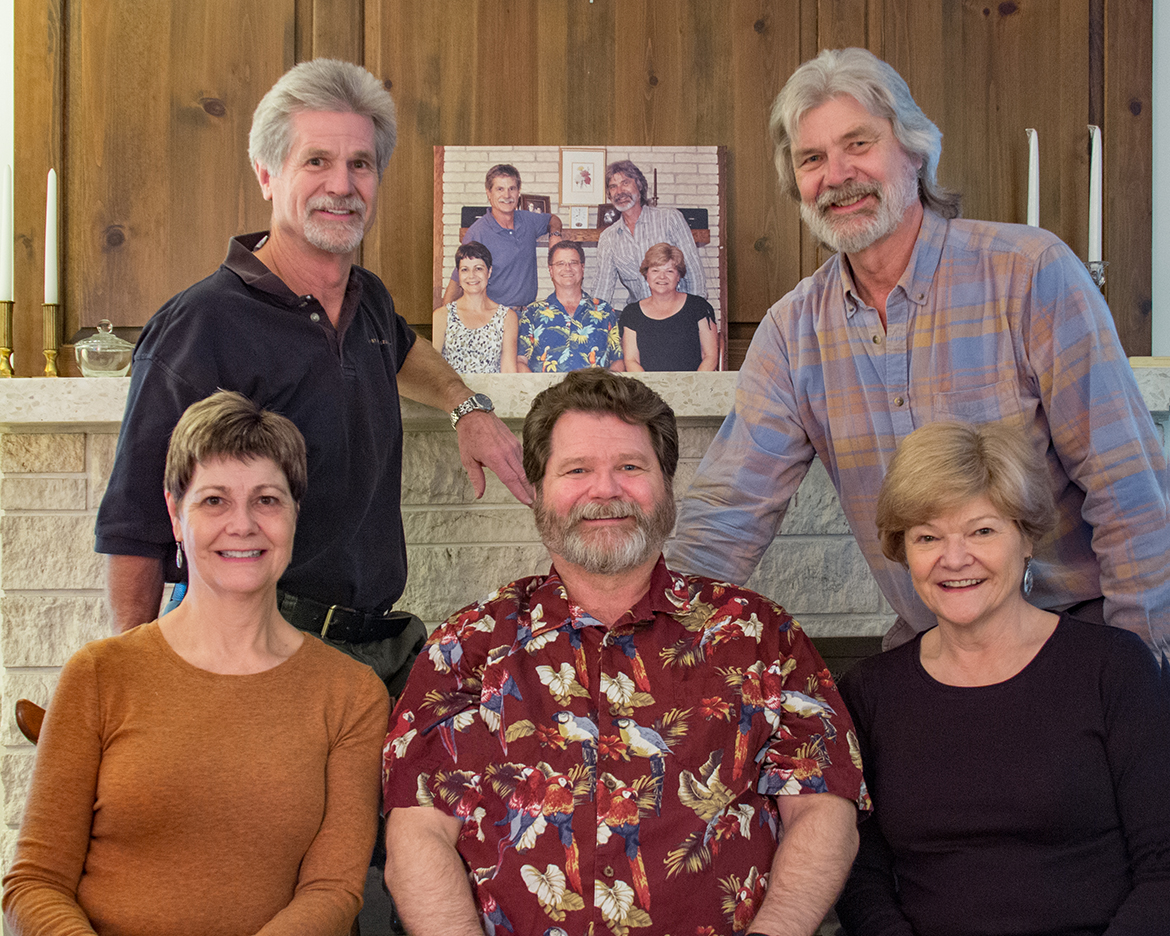
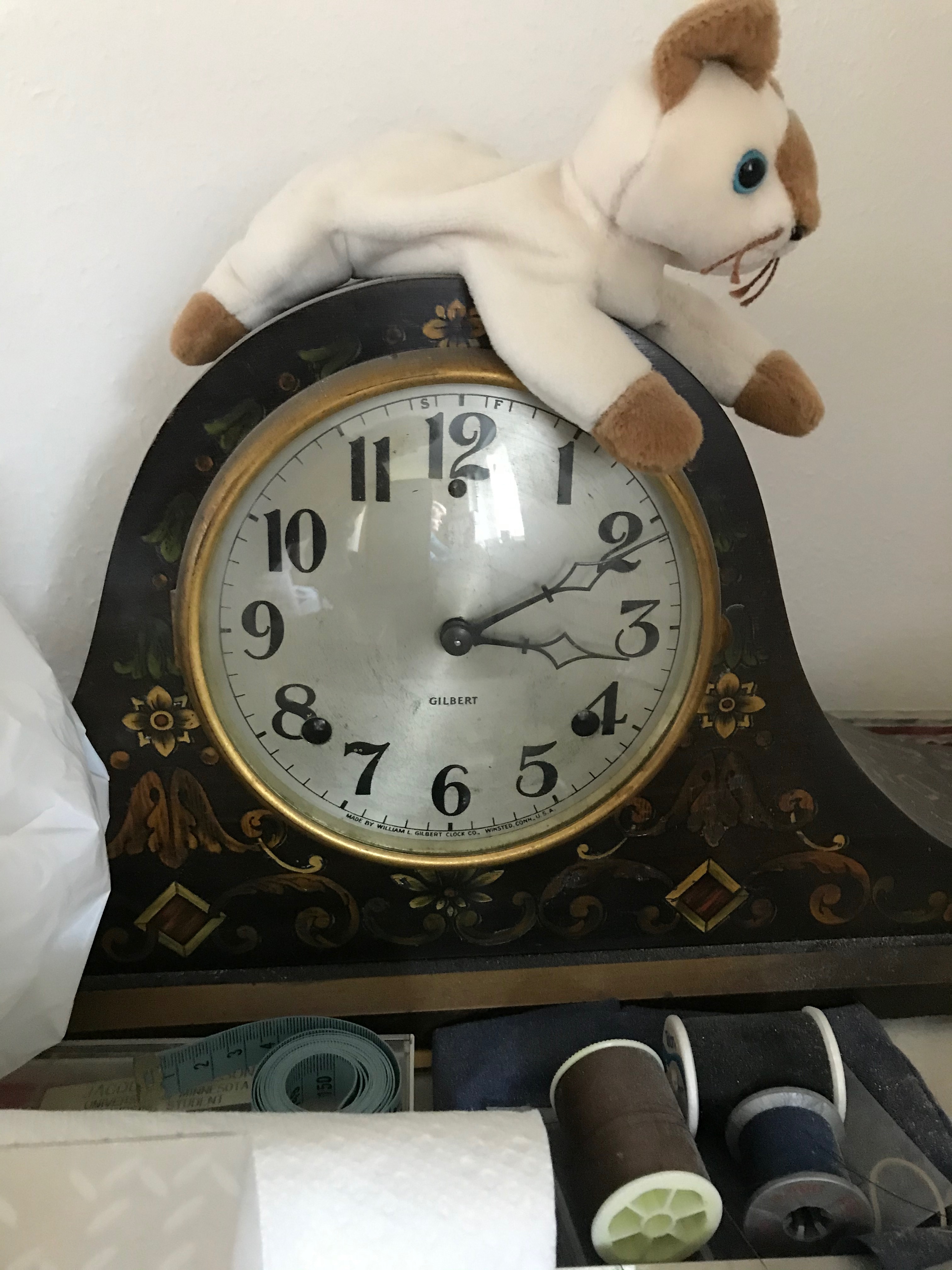
Eight years later, we re-create a photo given as a Christmas gift to our parents in 2011.
Growing up in a home headed by a “ham” (an amateur radio operator), we often would hear my dad’s radio conversations with remote, distorted, and static-filled voices. In one such contact, the usual exchange of technical banter was augmented by a personal one. Dad mentioned that he had a “full house”, the poker hand, in describing his children: three boys, and a pair of girls.
We all overheard such over-the-air dialogs, as well as evenings
filled with the clicks and beeps of Morse code. Such are the experiences of the children of a zealous
radio amateur.
But it has been a very long time since we were all together for any extended time under the same roof. My dad’s Morse code telegraph key went silent a few years ago, and it is the second passing of a parent that now brings us together to figure out the final disposition of their possessions.
The last time we spent this much time in such proximity we
were on a family backpacking trip in 1972.
It was a wonderful and new shared experience, but as teenagers there was
always plenty to bicker about. Some
things never change.
And although we still sometimes act like squabbling
siblings, the things we argue about are no longer the outrages of personal
space violations (“Mo-om, he’s looking at me funny”). Instead, they are the banalities of politics. On the things that matter, we all seem to
agree!
Over the course of four days we came together under the roof
of the house our parents enjoyed at the end of their lives and we applied our individual
strengths and skills to the task at hand.
We unearthed familiar artifacts, discovered old photos, revived faded
memories, and re-told family stories as the contents of a very full house were
processed by the “full house” of siblings.
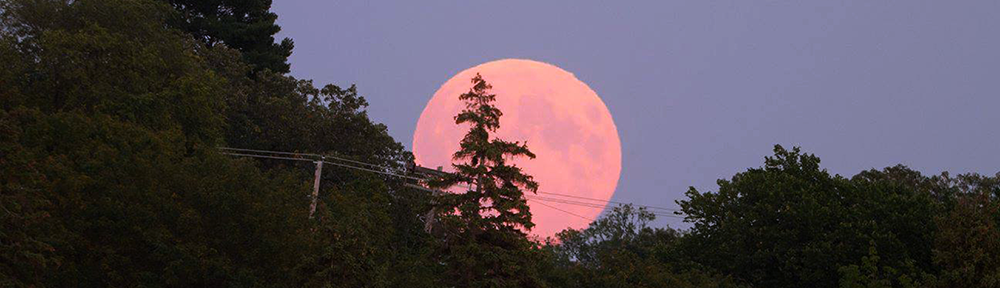
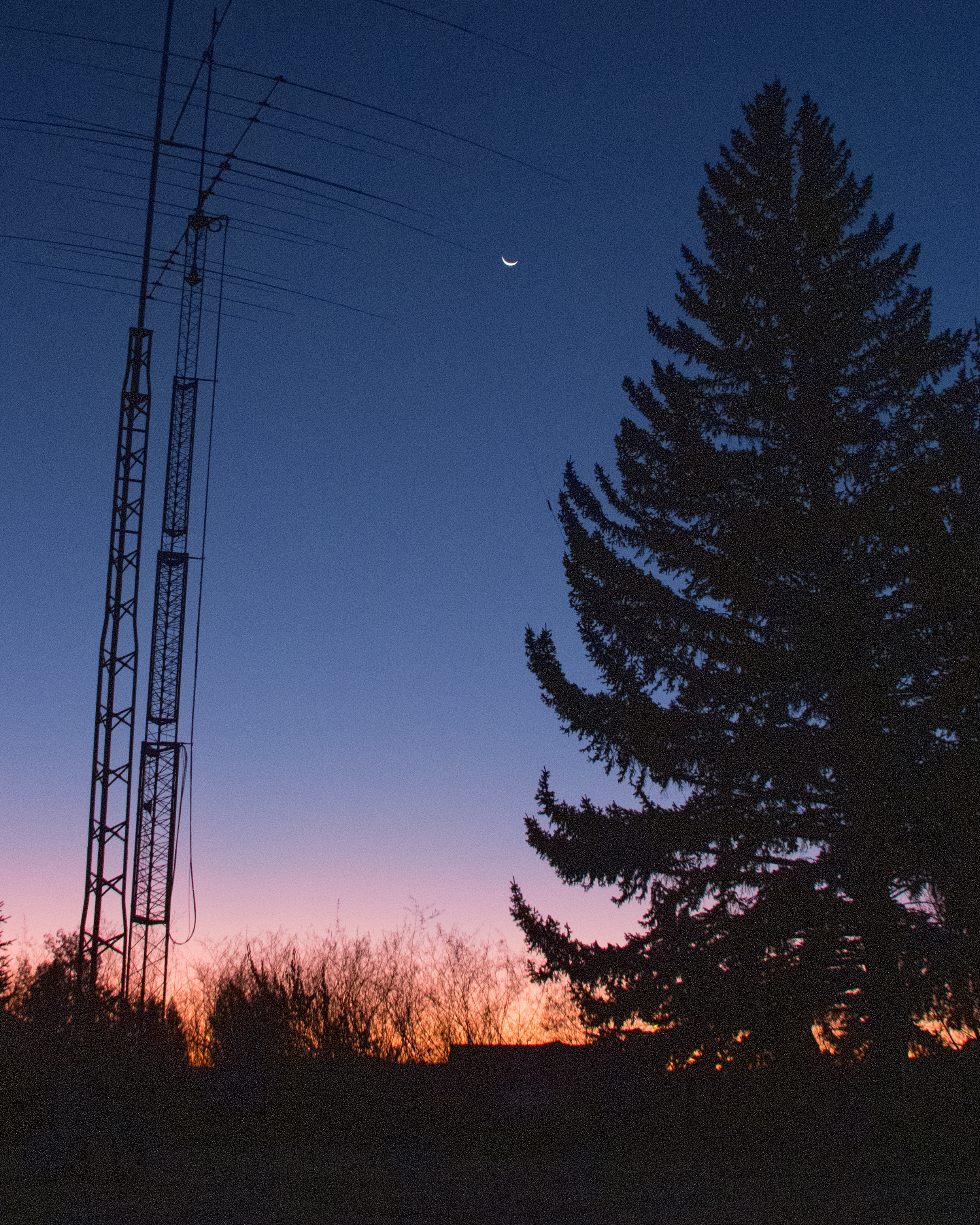
Jackie’s Last Moonrise. A view from her home in Idaho Falls where the landscape is shared with her late husband’s ham radio towers.
I am sad to announce the passing of my mom, Jacquelyn
(Jackie) Olson, who lived a full and active life until becoming limited by the gradual
but inevitable decline of health from COPD.
I remember her most as the central figure of a busy family;
her five children had diverse interests, and she encouraged all of them. She was the family manager, in charge of
feeding, clothing, coaching, logistics, cheerleading, and enforcing bedtimes. She set the house budget and found many innovative
ways to stay within it, becoming a do-it-yourself expert before DIY became a popular
acronym. She was fearless in tackling
new skills as needed, providing an example for all of us: that we could learn and become skilled at just
about anything.
As kids, we knew that she was quite talented; she could play
piano, operate a sewing machine, program a loom, make leatherwork, and ride
horses. I was surprised to find out that
she even had a darkroom, and at a time when my interest was aimed in this
direction, her equipment became my equipment, and I learned to develop film and
make prints.
Perhaps the strongest example of her brave approach to
learning was when she decided to go back to school and get a nursing degree. She was a student again, and despite the twenty-year
hiatus from her earlier coursework, she completed her first semester with an A
in chemistry, and all her other classes. My brother Eric and I were at the University
at the same time, neither of us quite matching her GPA. I recall meeting her for lunch sometimes at
the student union, along with some of her classmates. She was a generation older, but they all seemed
quite pleased to be hanging out with her.
She became an RN and worked at Waconia Hospital where she was liked and respected, confirming and adding to her sense of independence. She started applying her income to new hobbies: ceramics and upholstery, and one of her favorite activities was attending estate and yard sales, to find antique or underappreciated furniture, which she then restored.
In contrast to my dad, who offered explicit advice, boiling
down life lessons to memorable phrases, Mom taught by example. And not just how to hang wallpaper, but how
to be considerate to friends and respectful to non-friends, how to persist in
the face of obstacles and setbacks, and how to speak up when someone is not
doing the right thing. From her I
learned the skills of patience and persistence, and acquired the values for, if
not the skills of, being kind and attentive to others.
In 1997, she decided that Minnesota winters were no longer to her liking. The more arid climate of the West suited her better, and so she moved to Idaho Falls, acquiring Eric’s original house there as he built a new home for his growing family. (My dad reluctantly followed, never completely pulling up his Minnesota roots).
She has been happy there for these last decades, gardening
and landscaping and able to read as many novels as she wished, solve the daily
crosswords and keep up with neighbors, friends and family. In the last few years she has had to slow
down on her interests as her disease gradually overtook her body and
breath. It has been an unpleasant time,
and she has claimed that she has been ready to go for a while, but life is a
strong force and doesn’t give up without a fight.
The impact of her examples was not limited to her
children. She made friends all along the
way, from lifelong childhood friends, through college and sorority sisters, to neighbors
that had the fortune to move next door, and their children who are just now
becoming young adults. Many people will
miss her.
I will miss her.
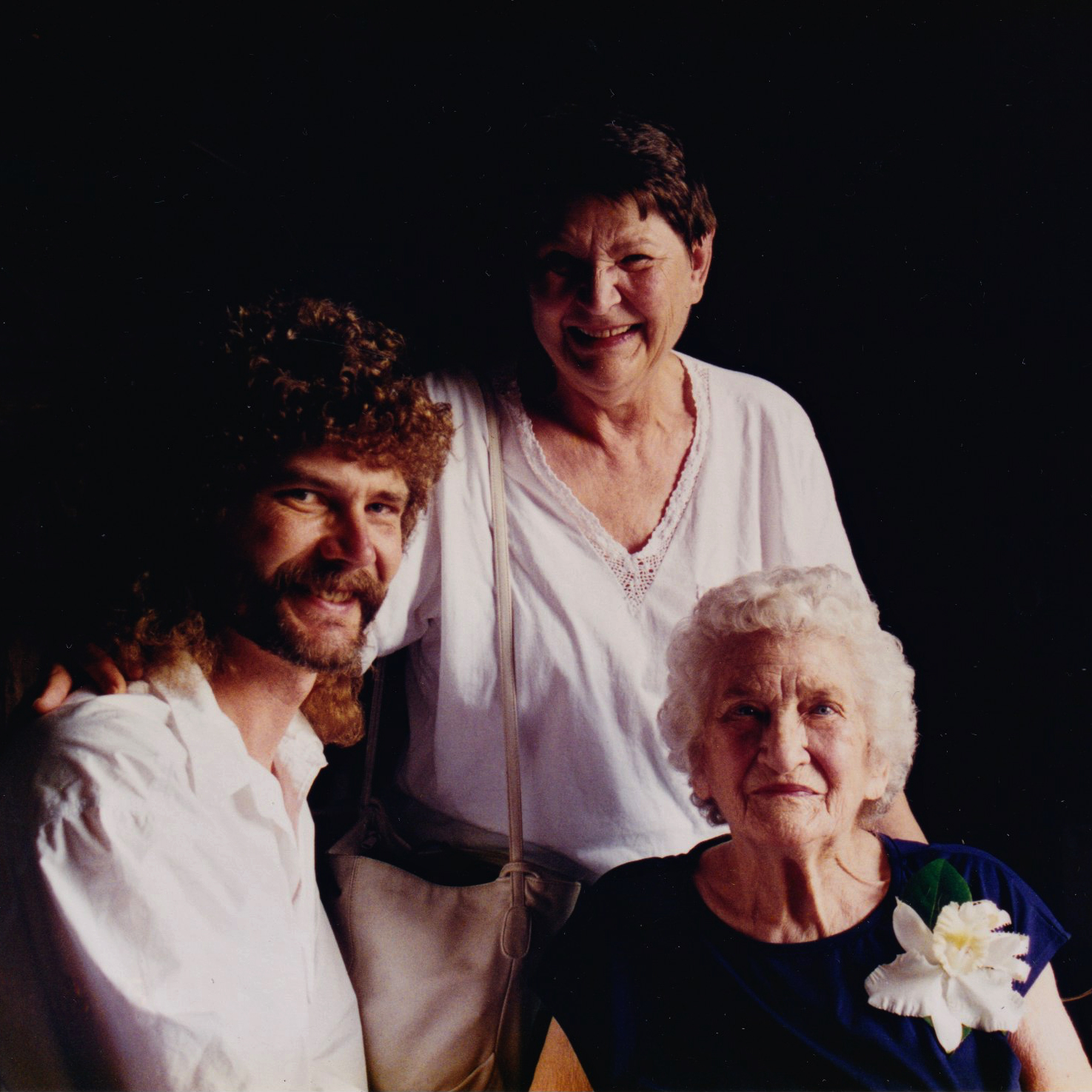
With my mom Jackie, and her mom, Theodora Pankratz, on Theo’s 90th birthday (1994).
Postscript
In an odd cosmic or spiritual coincidence, my mother took her last breath at 3:11, the time indicated by the stopped antique clock in her bedroom. It was the exact complement of the old song about the grandfather clock that stopped short when the old man died.
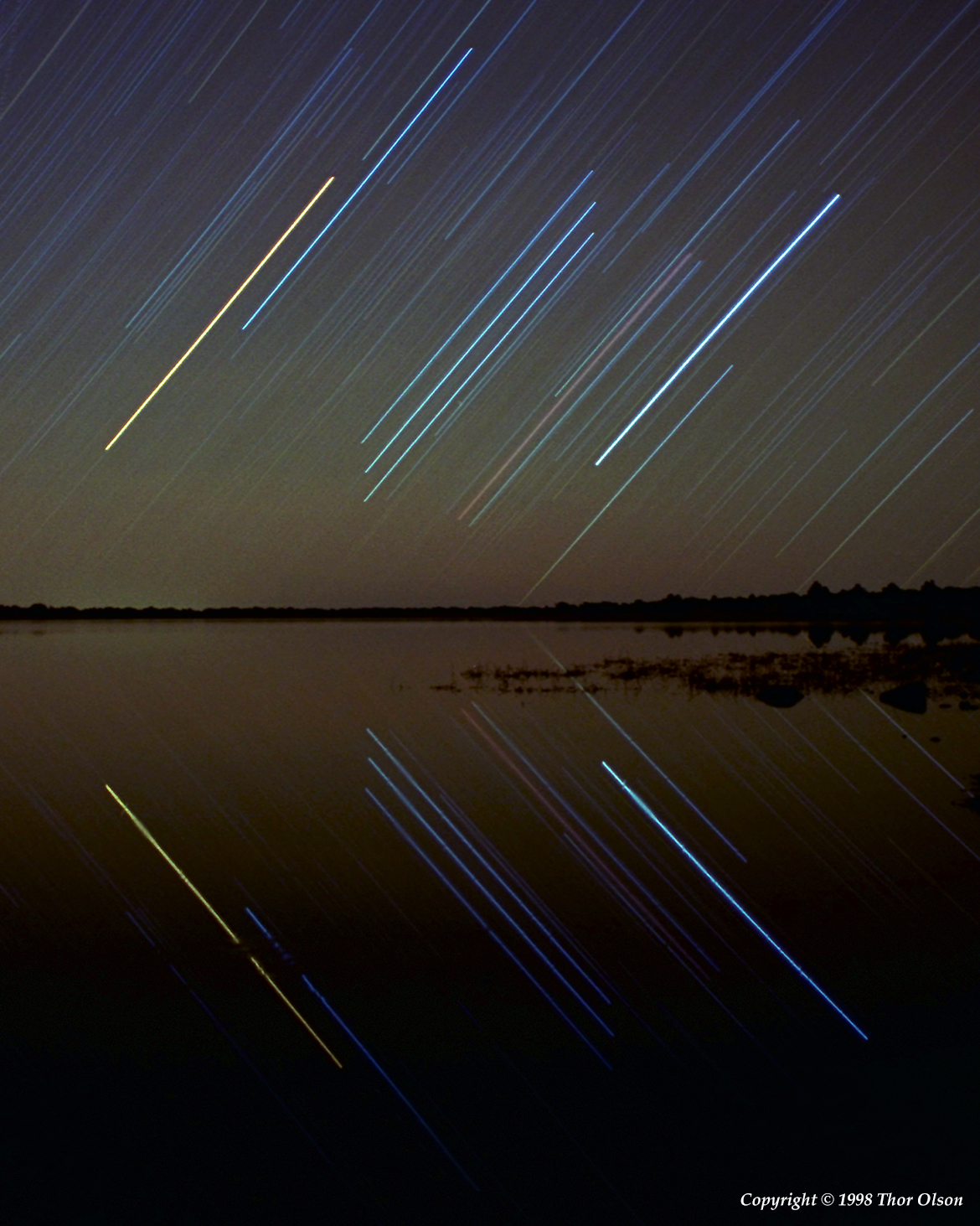
Orion Rising Kinnikinnik Lake, AZ, 14 Nov 1998 24mm Olympus lens at f/2.8, 1 hour exposure on Fuji 800 Superia
I made an expedition to northern Arizona in November of
1998. It was partly to find out what is involved in transporting photo and
telescope guiding equipment to other parts of the world. Although cumbersome (I
shipped a 90 lb crate ahead to be available when I arrived), it worked.
On the first night I found a remote site in the high desert.
The map showed what looked like paved roads to a fishing lake. Evidently the
map notations are different in Arizona; at least there were ruts where earlier
vehicles had found their way.
The lake was remarkably calm and I marvelled at the darkness
of the sky as I watched Orion rise in the east. I could hear wildlife including
coyotes, owls, and yes, ducks. But they were far away and the water remained
like a mirror. The sky glow here is not from aurora, but instead from distant
Flagstaff, a city with an ordinance to use sodium vapor street lighting. The
color is strongly yellow, but easily filtered and removed by the astronomical
observatories that are hosted by the town. My film however captures all of it.
Although Orion is spread out into an unrecognizable form, he
can be identified by the bright orange star, Betelgeuse on the left, and bright
blue star Rigel on the right. The triad of belt stars makes a catscratch-like
trail, and you may notice a distinctly red star that is even more obviously red
in its reflection. This is the famous Orion nebula, a glowing region of gas and
dust where new stars are being born.
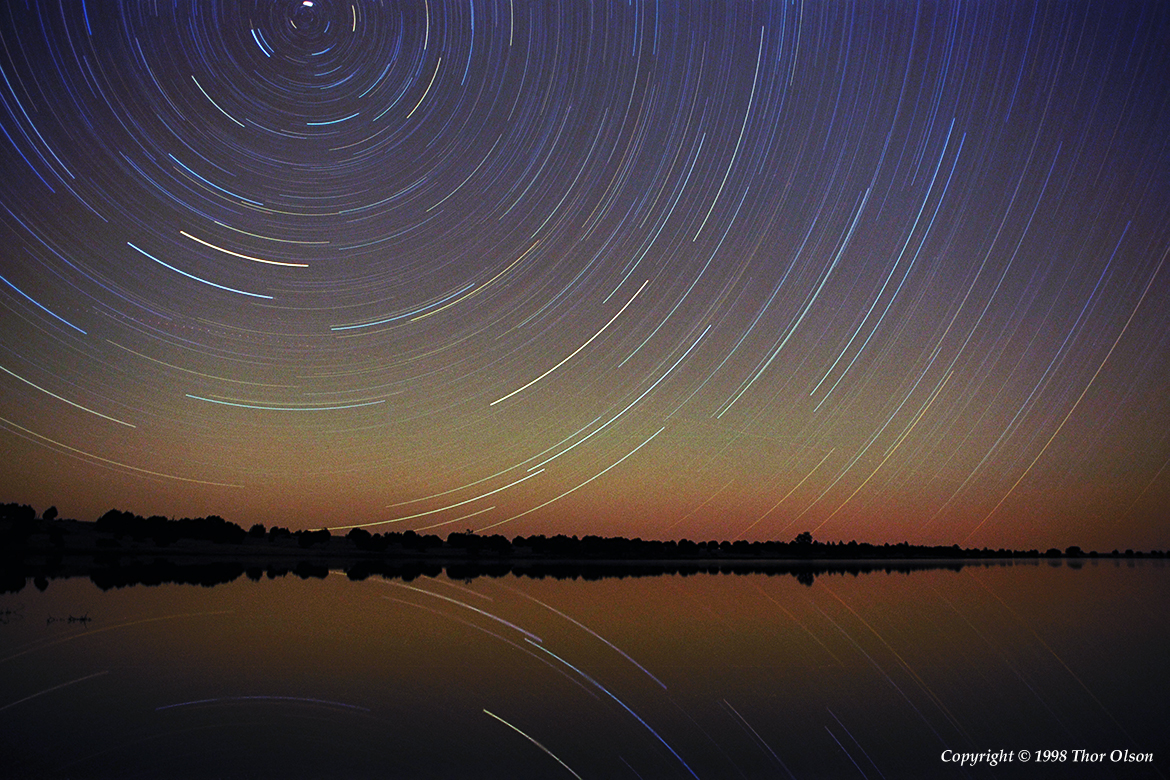
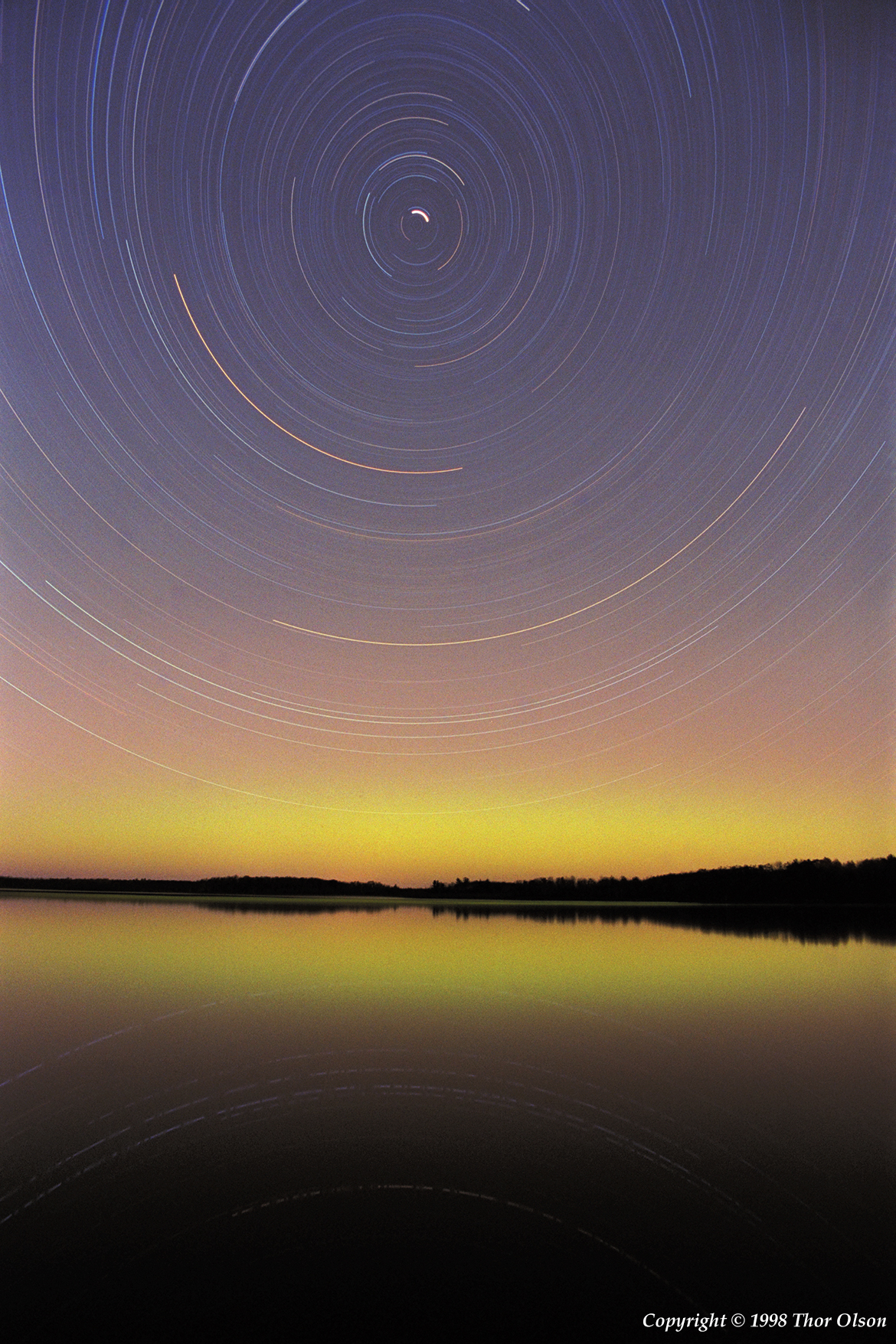
Kinnikinnik Kinnikinnik Lake near Flagstaff AZ, 14 Nov 1998 24mm Olympus lens at f/4, 2 hours on Fuji 800 Superia
There is a progression of techniques in taking pictures of
the night sky. The simplest is to place your camera on a tripod and open the
shutter for a while. The stars form streaks on the film as the Earth rotates
under them, creating a startrail image. As I considered what I would need to
take more advanced astrophotos, I found that there is plenty to learn and much
opportunity for pleasing compositions even with this simple method.
I pondered how to capture that feeling I once shared with a
friend seeing the stars from zenith to horizon, then continuing beneath us as
we looked out over their reflections in an alpine lake. This became the
inspiration for my quest of the ultimate startrail picture: a full semicircle
of startrails reflected in the calm waters of a lake. I have not achieved this
goal, but the pictures in this series are some of the rewards along the way.
Kinnikinnik is the closest I came to making my target image!
The conditions were perfect: a clear dark sky, no aurora, a calm lake with no
creatures disturbing it, but my timing is off. This is my first and only time
at this site and I arrived late after a day of traveling. I was unprepared to
last the night, and after a few one and two hour trial exposures, I succumbed
to the cold and returned to my distant hotel room to recharge. I never made it
back.
Although not successful that year, I am looking forward to
more adventures in future years. In a way, I hope I never quite find full
success in this project!
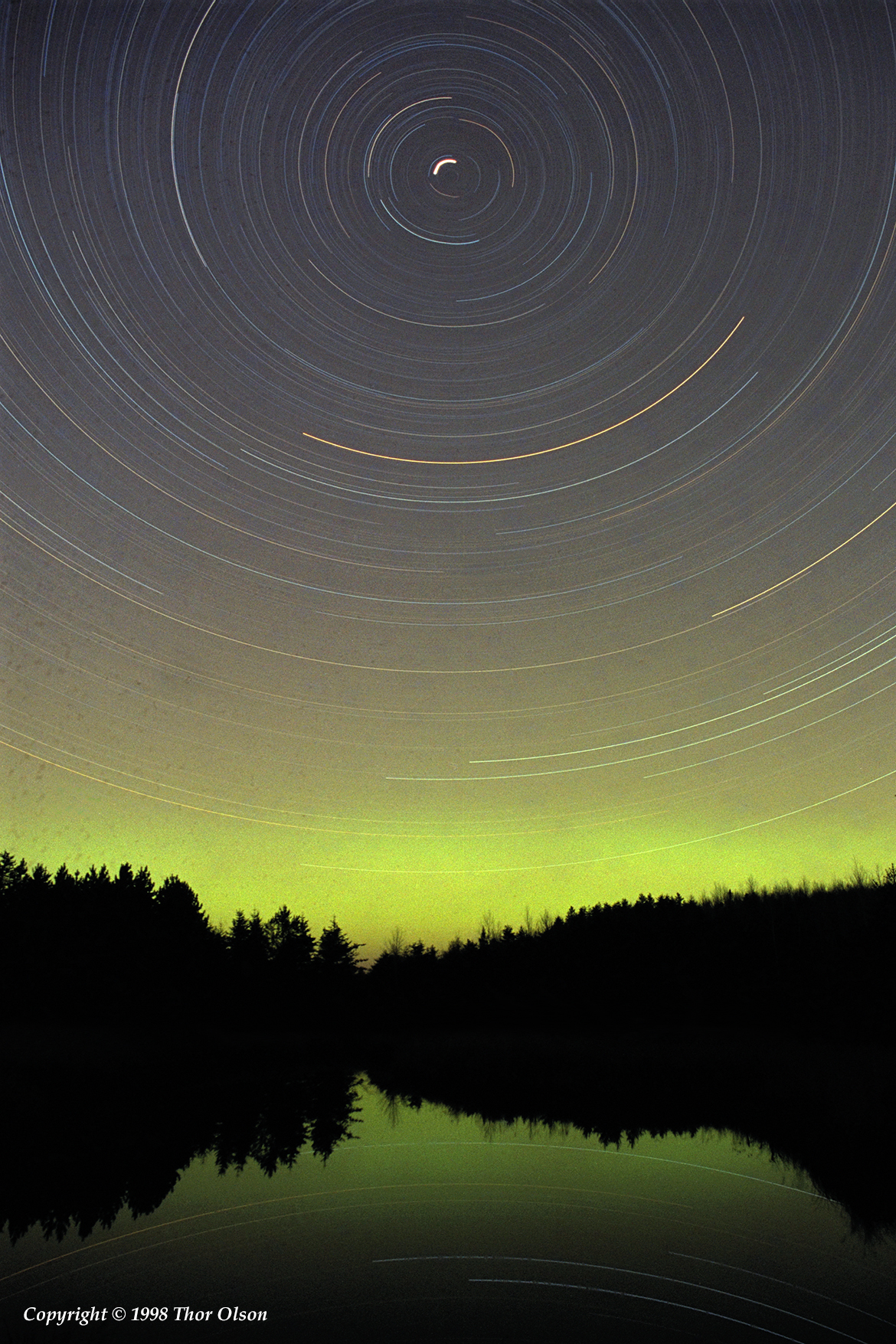
Northern Six-Hour Exposure Boundary Waters Canoe Area, MN, 23 Oct 1998 24mm Olympus lens at f/8, 6 hour exposure on Fuji 800 Superia Photo by John Walsh
To find truly dark skies, go north. My friend John Walsh, an avid backpacker, headed to the northernmost part of our state for a fall weekend adventure. I convinced him to take my camera and film, explained how to attach chemical handwarmers to the lens to keep it from fogging over, and asked him to open the shutter for six hours when he got there. Among his other nice photos of aurora and bright stars, is this beautiful picture across a gently flowing stream, reflecting the night sky and the northern lights.
Beaver Trails Swamp Lake, north of Mille Lacs MN, 21 Oct 1998 20mm Nikon lens at f/8, 6 hour exposure on Fuji Super-G
This night had brought together nearly all the elements for
my target picture: a lake far away from
city lights and radio towers, one with no cabins or roads on the north while I
had access from the south, a long night to contain a long exposure without the
lake being already frozen, a stagnant high pressure center stalling the winds
and keeping the lake surface at a mirror finish. And my schedule had allowed me to take a
night away to make the shot! All these
prerequisites had been met.
I set up my equipment and busied myself with other
activities while the camera recorded the motion of the sky. A loud KERSPLASH startled me. Who would be throwing boulders into the lake
in the middle of the night? I peered out
onto the lake to see dark shadows swimming back and forth directly in front of
my camera. Each traversal left a wake
breaking up the reflected starlight.
Occasionally a shadow would suddenly turn over end and dive, slapping
its tail onto the water surface to make the boulder-throwing sound.
I cursed the beavers.
They filled the night with constant gnawing sounds as they busied
themselves around me. About halfway
through the night I was startled again, this time by the sound of a tree
crashing to the forest floor next to me.
One more hazard to add to my list.
The picture I obtained was almost perfect, accented by the
glow of the northern lights, and the intermittent breaks in the reflected
trails as the beavers swam across the view, oblivious to my intent.
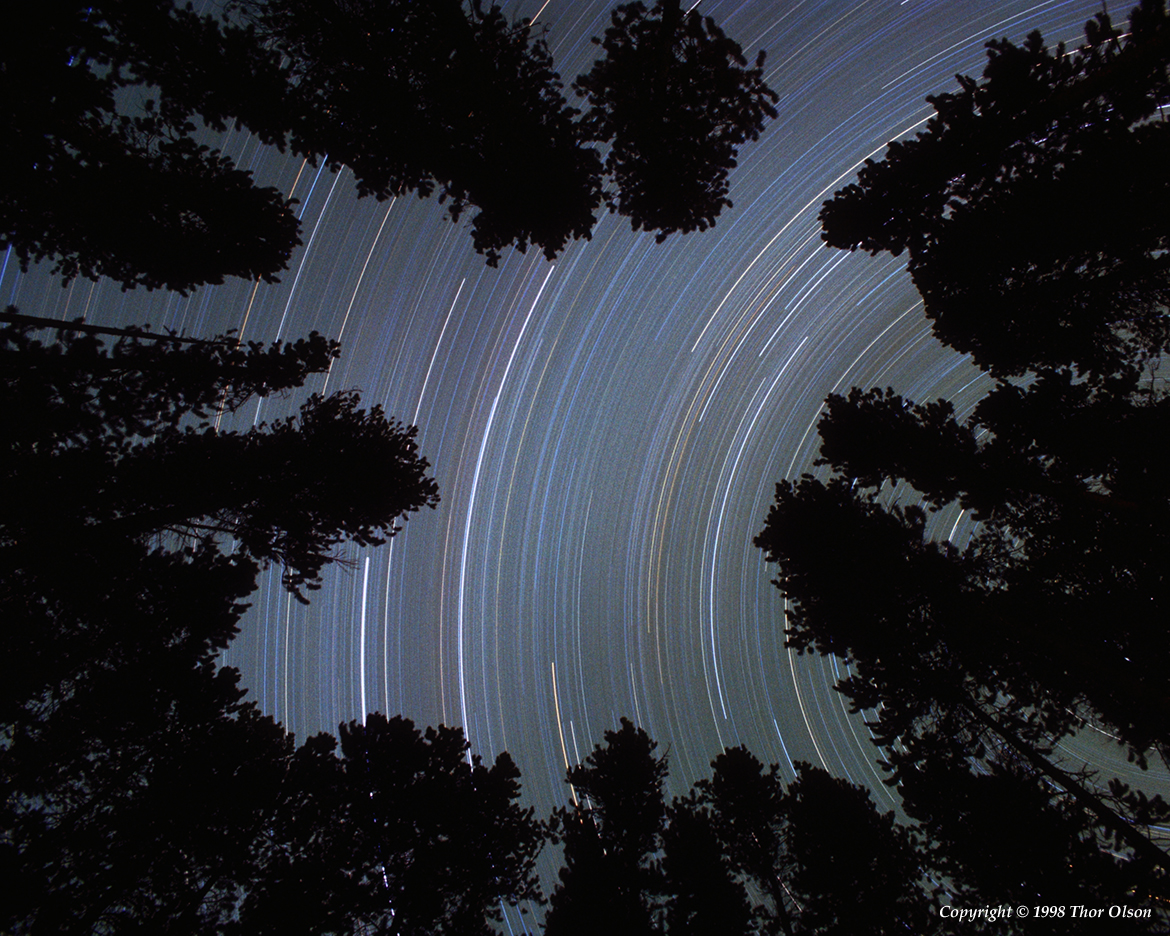
Four-Hour Lodgepoles Lake Louise Campground, Banff Park, Alberta Canada, 12:00am 19 Aug 1998 20mm Nikon lens at f/8, 4 hour exposure on E200 Ektachrome processed +2 stops (ISO 800)
Think about lying on your back as a child watching clouds drifting past. This is the nighttime equivalent. The stars etch a trail on the film as they follow their course through the night. The different temperatures of stars show as different colors, the cooler stars glow a warm orange, the hottest stars are a bright blue.
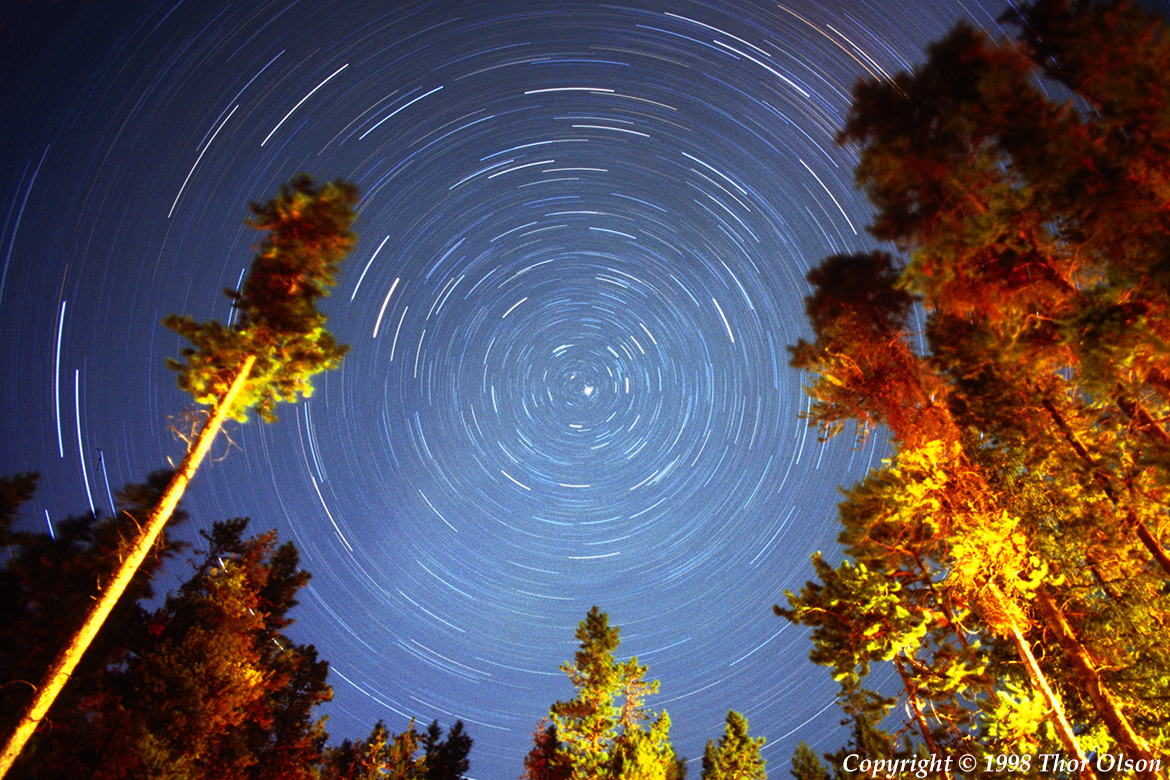
Banff Poles Tunnel Mountain Campground, Banff Park, Alberta Canada, 17 Aug 1998 10:40pm 20mm f/4 Nikon lens, 1 hour exposure on E200 Ektachrome processed +2 stops (ISO 800)
While camping trips make great venues for photographing the
sky, sometimes it is difficult to get a full view of it. But here is an opening
in the canopy, the lodgepole pines framing the pole star. The camera was aimed
at Polaris, and the shutter opened for an hour. The flickering campfires and
lamps illuminated the boughs of the trees.
A startrail picture like this is a powerful illustration of
the Earth’s motion. The pole star shows almost no motion. The others show
longer arcs the further away, but all of them make an equal arc: a one-hour
exposure cuts 1/24th of a full circle.
When we consider the impact of computer graphics we usually think
of Hollywood motion picture special-effects, or beautifully crafted images and
commercials from high-end marketing firms, which both seem like products of the
east and west coasts. We don’t think of midwestern
artists or public university departments as being part of that world. Yet this is exactly where much of the
pioneering work in computer graphics was done and its commercialization was
born.
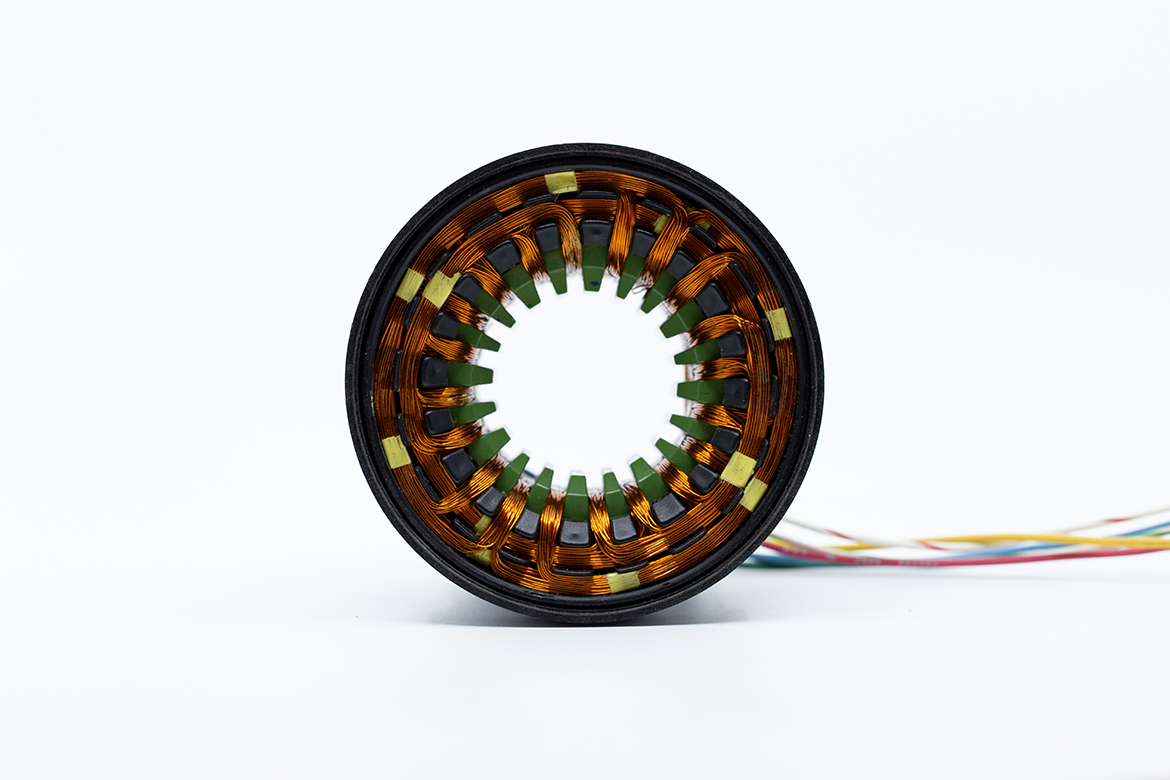
The coils that provide the magnetic force to move the electron beam
Cathode ray tubes are a remarkable technology that incorporate many seemingly magic principles of physics. Thermionic emission causes electrons to “boil” off a cathode, high voltage electric fields accelerate and focus them, and magnetic fields steer them to the anode screen where they energize phosphor molecules, which then re-release that energy as visible light!
While developing the electronics to control the CRT and make
all this magic happen, we often had to “bring up the spot”, showing the
electron beam in one static location, where it could be examined visually and
measured with various instruments.
This was always a tricky maneuver, because if the electron
beam were allowed to become too intense, the energy transfer to the screen
would cause it to heat up to the point where the phosphor would suddenly
vaporize, leaving a dark spot that could never be lit up again. Usually, this burn-hole was in the middle of
the imaging area, and so the CRT, the single most expensive component in the
system, would become instantly unusable.
To avoid this event, there was a standard procedure for bringing up the spot: apply voltage to the CRT and gradually increase it, sneaking up on the level where the spot would become visible, and then avoid going too far. The safe operating zone was rather small.
But even the best procedures cannot anticipate every possible
experiment and test that might be needed while inventing new technology. Consequently, there were situations where the
beam accidentally and unexpectedly reached the critical phosphor burn level,
and whoever was conducting that particular test suddenly realized that they had
crossed the threshold and now the CRT had a permanent blemish. They had become a member of “the burn-hole
club”.
The burn-hole club comprised everyone who had suffered this
unexpected event. It was both an
embarrassment, and a badge of honor. It
was awful to realize that an expensive component was now worthless, but on the
other hand, the tests and experiments that we were conducting were on the
cutting edge of our knowledge, the term “cutting edge” implying that injuries
were part of the process. Only brave
researchers dared to push this edge forward.
I am not a member of this exclusive club, but that is
because I had skilled technicians who knew far better than I how to conduct the
tests I requested. They were on the
front lines of the technology. And as a
result, they were the ones first inducted into the burn-hole club.
There is one incident that deserves special mention. It occurred during the development of the
brightness calibration method, a critical part of making accurate exposures
onto film. We used a photocell at the
far edge of the screen. It needed to
“see” the spot, and measure how bright it was.
The task of figuring out how to do this was assigned to Rick Keeney, who
became a master of writing code to control the complexities of driving a
cathode ray tube.
To solve this particular problem, Rick came up with a clever
algorithm to position the beam directly under the photocell. The exact horizontal and vertical position of
the photocell is not known, at least not at first. It needs to be located. So Rick made a first best guess, and then
refined it. By moving the beam slightly
horizontally and vertically and seeing if the light seen by the photocell
increased or decreased while doing so, the beam position could be
estimated. Move the beam to where the
light measurement was strongest, and that would be the location directly under
the photocell.
But if the photocell light level was low, it was hard to
know which way to move, so increase the intensity of the electron beam and try
again. And if that didn’t help, then it
was likely that the beam was not quite where it was expected. So move it over a little bit and try again. This was the strategy for locating the beam
and calibrating its brightness. It worked
fairly well… until it didn’t.
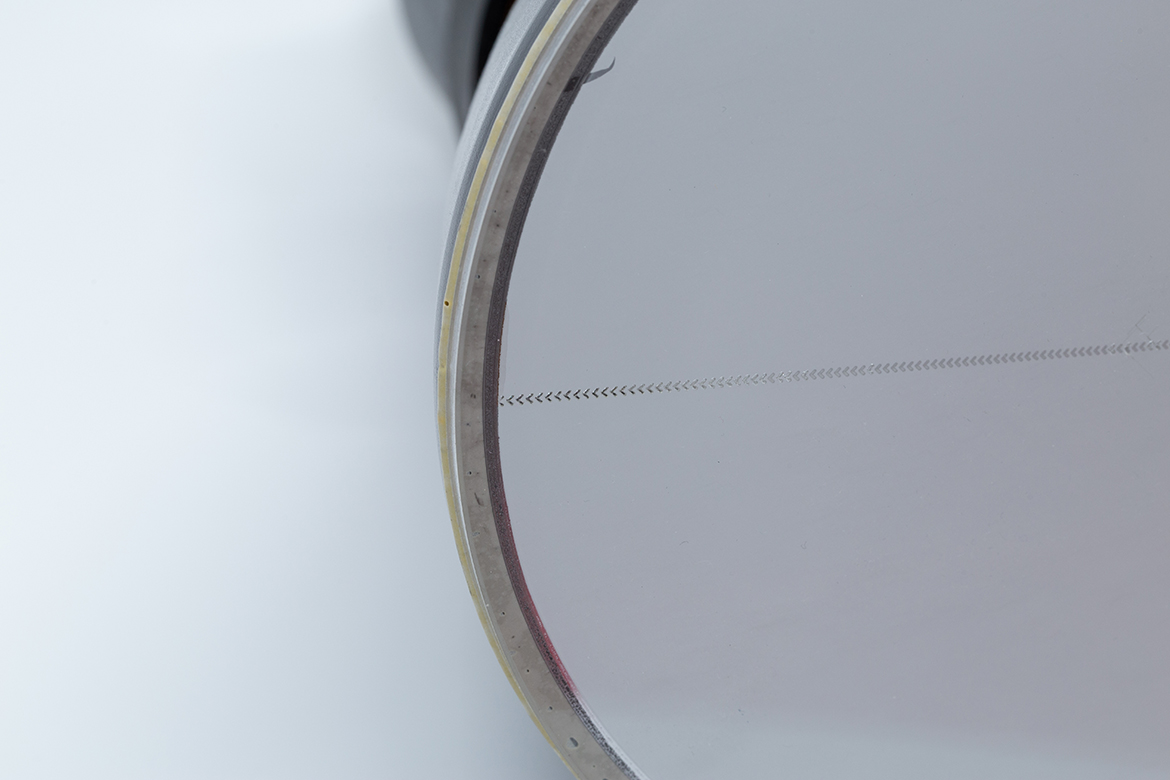
On one occasion, the beam could not be detected at all. The algorithm increased the intensity trying to measure the light, but as it did so, burned the phosphor in its path. When it failed to detect the beam, it moved over a little bit and burned the phosphor there too. Since the beam was still not detected, it was moved a little more and tried again. The algorithm didn’t have a limit check on position, so it marched all the way across the full width of the screen, leaving behind a tire-track of vaporized phosphor.
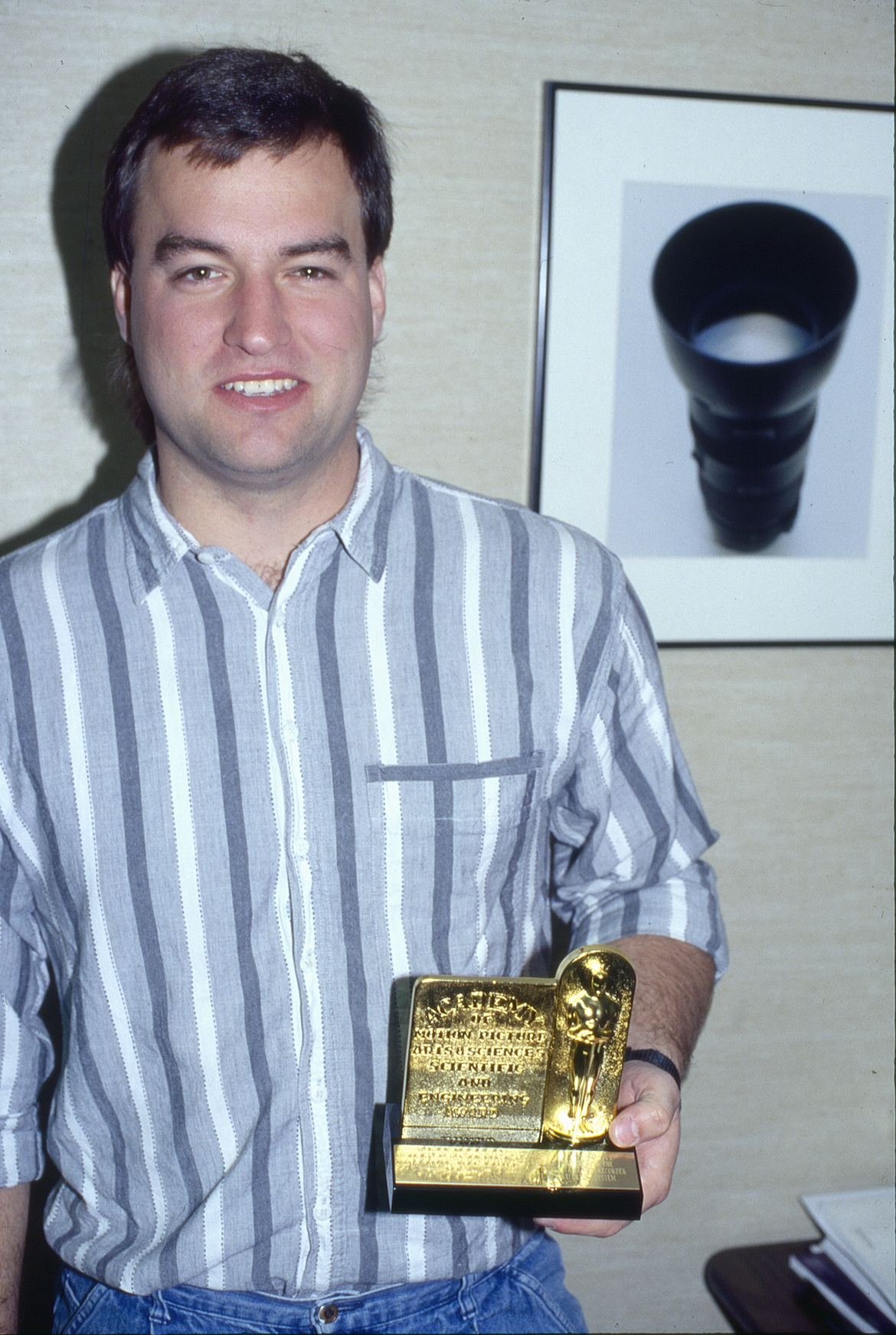
This was a spectacular example of damage by electron bombardment, and Rick Keeney, in addition to being an Academy Award winner, also holds the prime honor in the burn-hole club. And I have the privilege of curating the resulting damaged tube.
The trail of damaged phosphor, leading right off the edge of the screen.
Rick with a more public acknowledgement of his skills in pushing the cutting edge of science and technology.