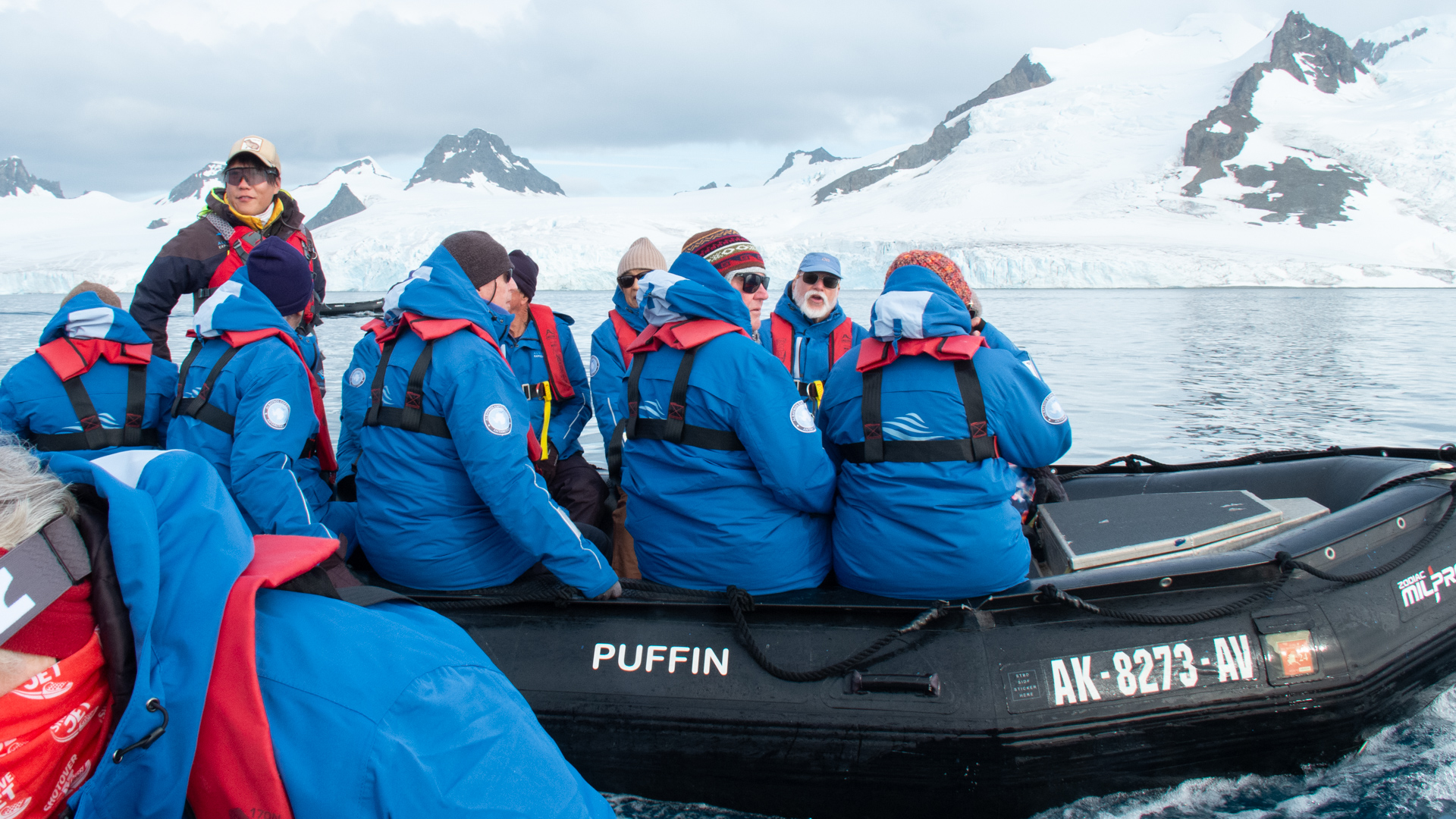
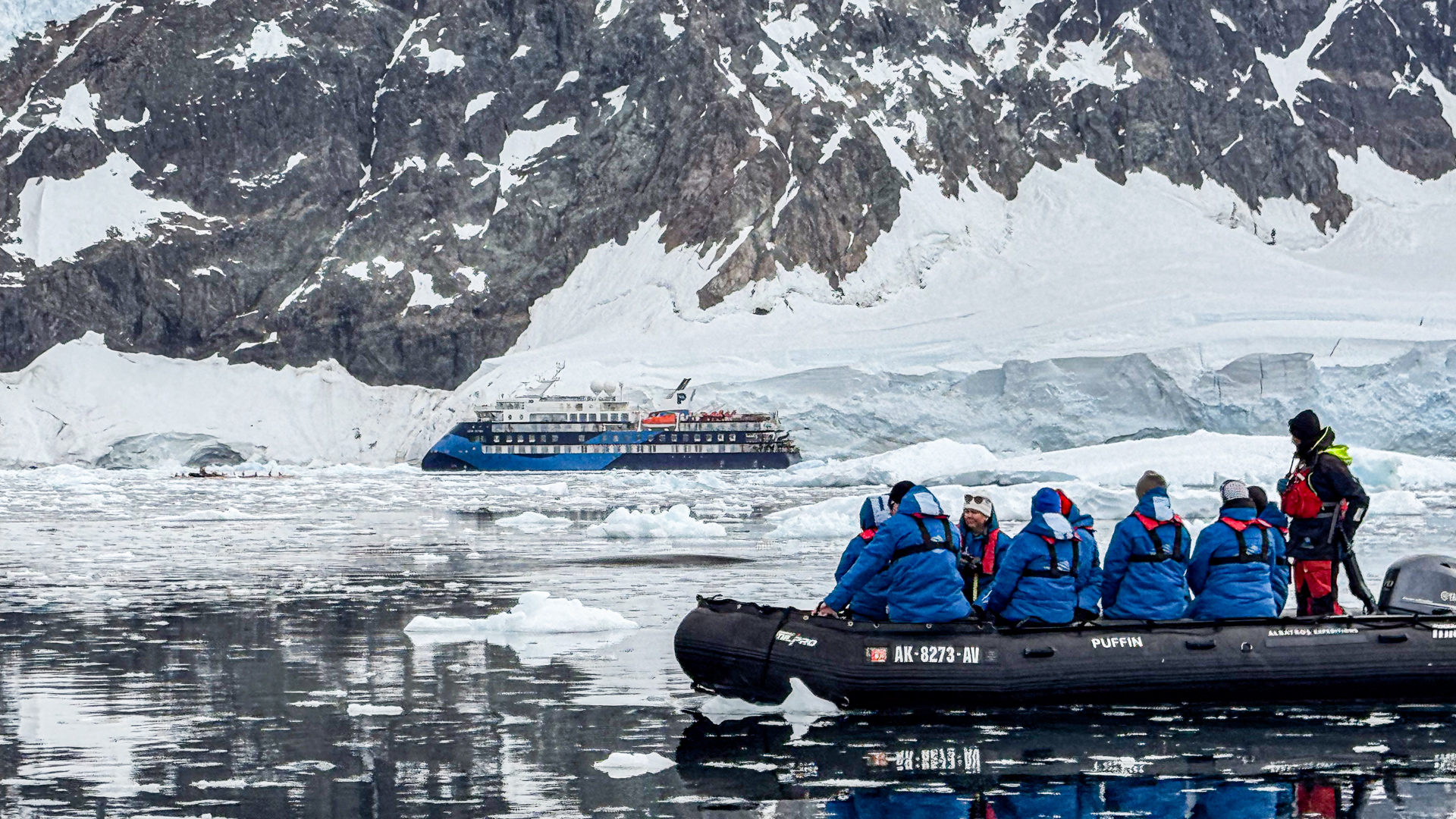
“Zodiac” is a trade name for the small boats made by the original manufacturer, Zodiac Nautic, but it has become a generic reference for inflatable boats of this type. Ocean Victory has a corral of twenty such boats (from Zodiac-Milpro, the military/professional division of the company).
The management of passengers onto and off of these crafts is no small matter. We were given detailed training instructions on how to step into and off of them from the “mudroom” deck only a few feet above sea level. We were taught the “seaman’s grasp”, a double handlock with the crewperson assisting us on and off the Zodiac. There were strict rules about how and where to sit on the rubber pontoons. No standing without permission.
Barrientos in the South Shetland Islands was a bonus stop, one which was possible because of our smooth transit of the Drake Passage. And if the weather was favorable now, but uncertain later, the expedition crew wanted to make sure that their passengers would have at least one landing experience on this tour.
The good weather held, and our next stop was to the actual Antarctic Peninsula at Foyn Harbor and Portal Point. We could finally say that we had set foot on the seventh continent.
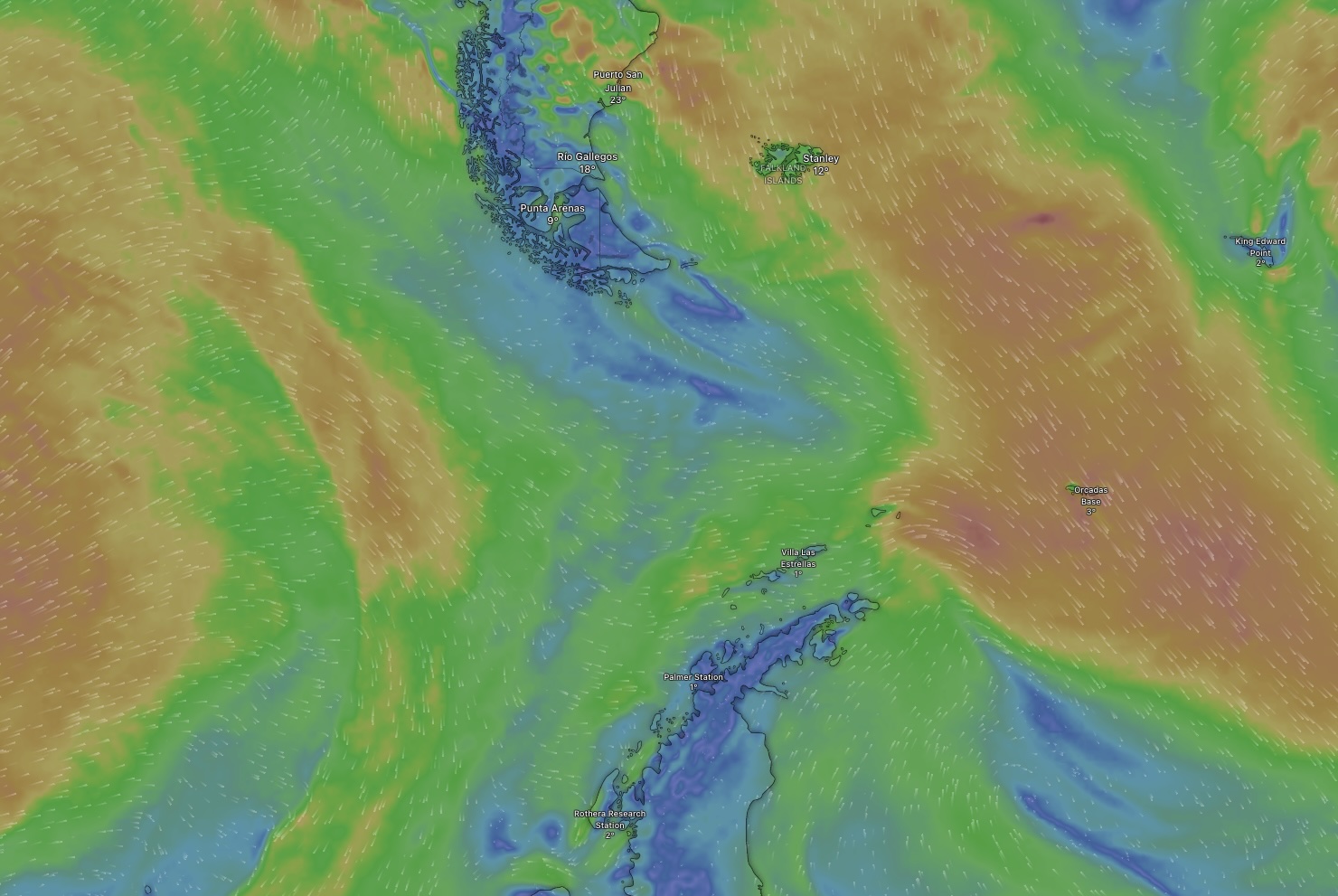
Screenshot from windy.com, a site that makes predictions of the wind speeds and wave heights. We were most interested in the area between Tierra del Fuego and the Antarctic Peninsula.
Among the other things about which the tour operators cautioned lowered expectations, was the ease of crossing the Southern Ocean, a notoriously challenging passage famous for foul weather and high seas. The 1000 kilometers between Argentina and the Antarctic Peninsula is known as the Drake Passage. We had heard rumors of the tour that had immediately preceded us: the wind and waves were so extreme that they had to abandon their planned route to Antarctica and instead travel to the Falkland Islands. Their tour featured many Antarctic-like things, including Emperor Penguins (which we would not encounter), but it was not Antarctica. And I don’t think anyone’s travel insurance would cover that distinction.
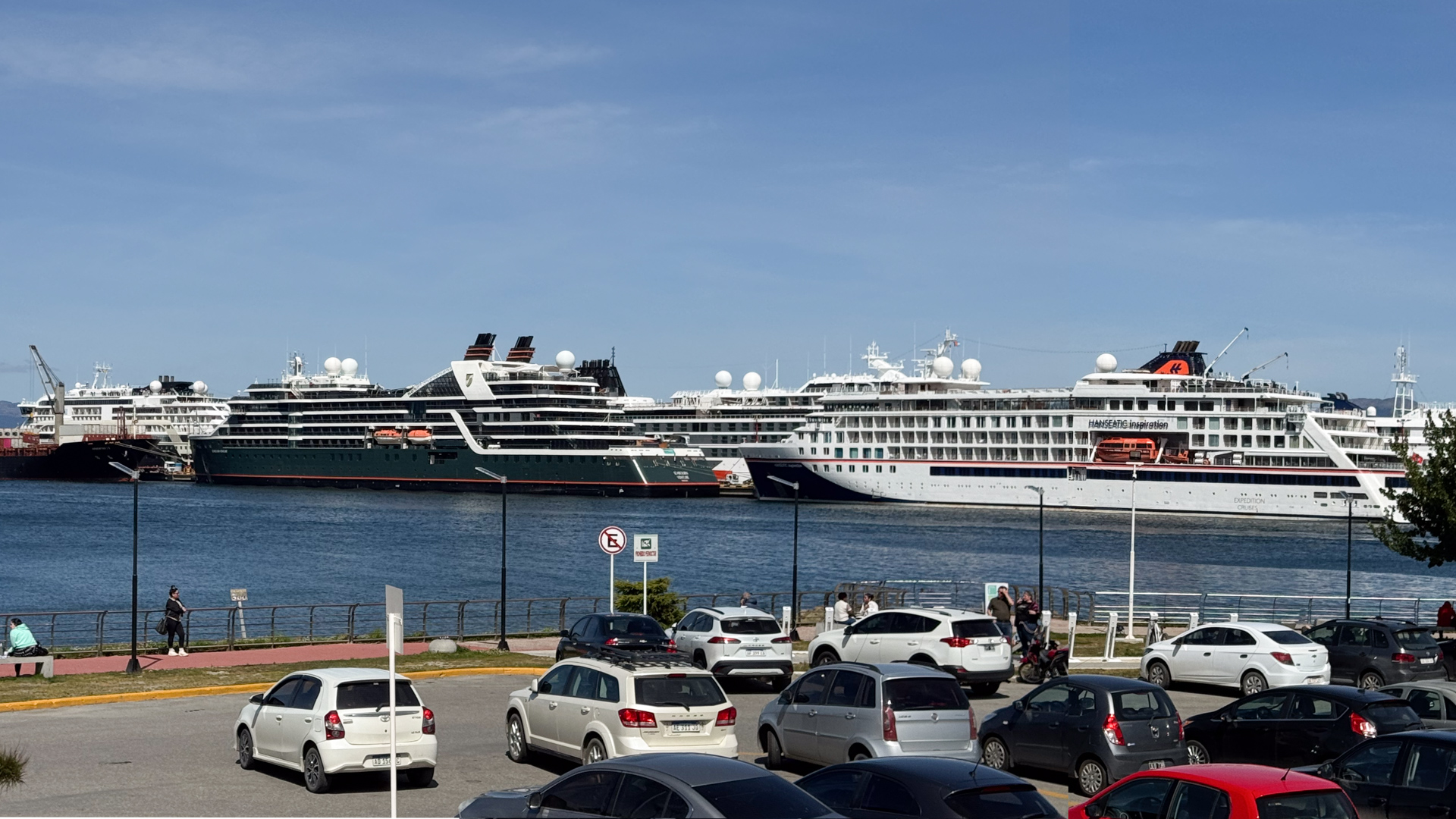
The harbor at Ushuaia Argentina, with tour ships preparing for their next voyage. These are “expedition class” ships capable of navigating the icy waters of Antarctica..
The heart of the Road Scholar Antarctica tour is a 9-day voyage on an “Expedition Class” ship, the Ocean Victory. The ship’s schedule is fixed; when it departs the dock, there is no taxi or flight to catch it at the next stop– “that ship has sailed”.
I have written about my visit to the “Top of the World Store”, and now I get to write about visiting the “End of the World”, which is what the town of Ushuaia in Argentina calls itself (Fin del Mundo). And beyond the end of the world lies… Antarctica!
I have lobbied to see the seventh continent for a few years now, and after testimonials from friends who have taken that trip, Poldi showed some interest. It is not natural for her; she’d rather go someplace warm in the midst of our Minnesota winter, not to an ice-covered land populated by penguins. But she will sometimes admit regret at not joining me on an aurora viewing tour in northern Sweden because of concern about the subzero temperatures. It turned out that it was subzero Centigrade, not Fahrenheit, a big difference.
And the same was true in Antarctica. The weather would feature the summer temperatures of the southern hemisphere, a time when wildlife returns to feed on the rich nutrition of the Southern Ocean. Seabirds and sea mammals are abundant, the ice is melting, and outlandishly shaped icebergs provide landing zones for them.
It is an expensive trip and I later learned why (keep reading). And unlike during grade school when I first learned about Antarctica, and when only research scientists could travel there, we now have a choice of tour operators that cater to sufficiently adventurous travelers. They are not all equivalent however, and we encountered communication difficulties with the first company we approached to book a trip. Considering it a red flag, we shifted to the group we had had a very positive experience with for our tour of the Baja Peninsula. Road Scholar is a nonprofit organization that caters to “lifelong learners”, people who would rather listen to a lecture than go shopping at the tourist malls. Perhaps it is not surprising that their clientele skew older (mostly above 50). This is ok with us, and in fact, this self-selected demographic fits us just fine.
Their prices were higher, but having had one positive experience with them, and considering the overall uncertainty of this particular tour destination, we signed up. We were not disappointed. They were responsive to all of our questions and accommodating to our schedule (we had travel days of our own before and after their itinerary). They took care of us throughout.
I will be making a few travelogue-type blog posts about this trip and offer a few photos. I hope you enjoy them.