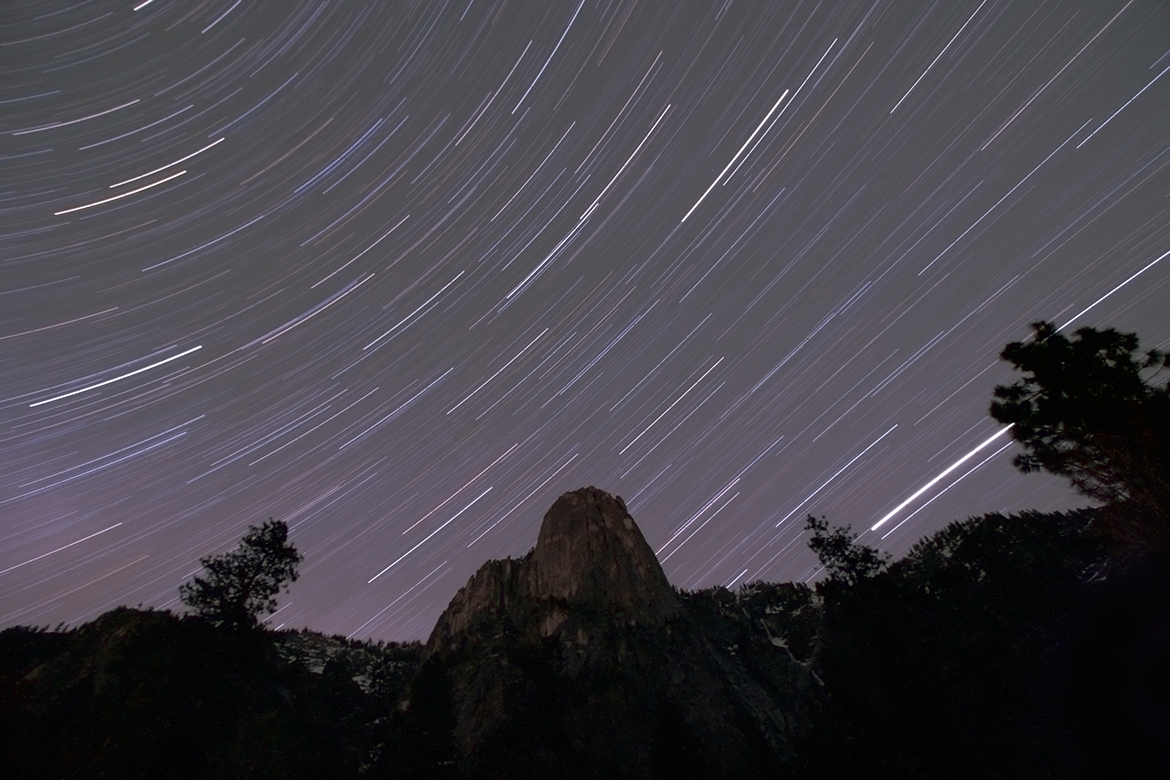
Sentinel point in Yosemite National Park. One of my first digital startrail images comprises four exposures of 15 minutes each. Image composited and noise reduced in Photoshop.
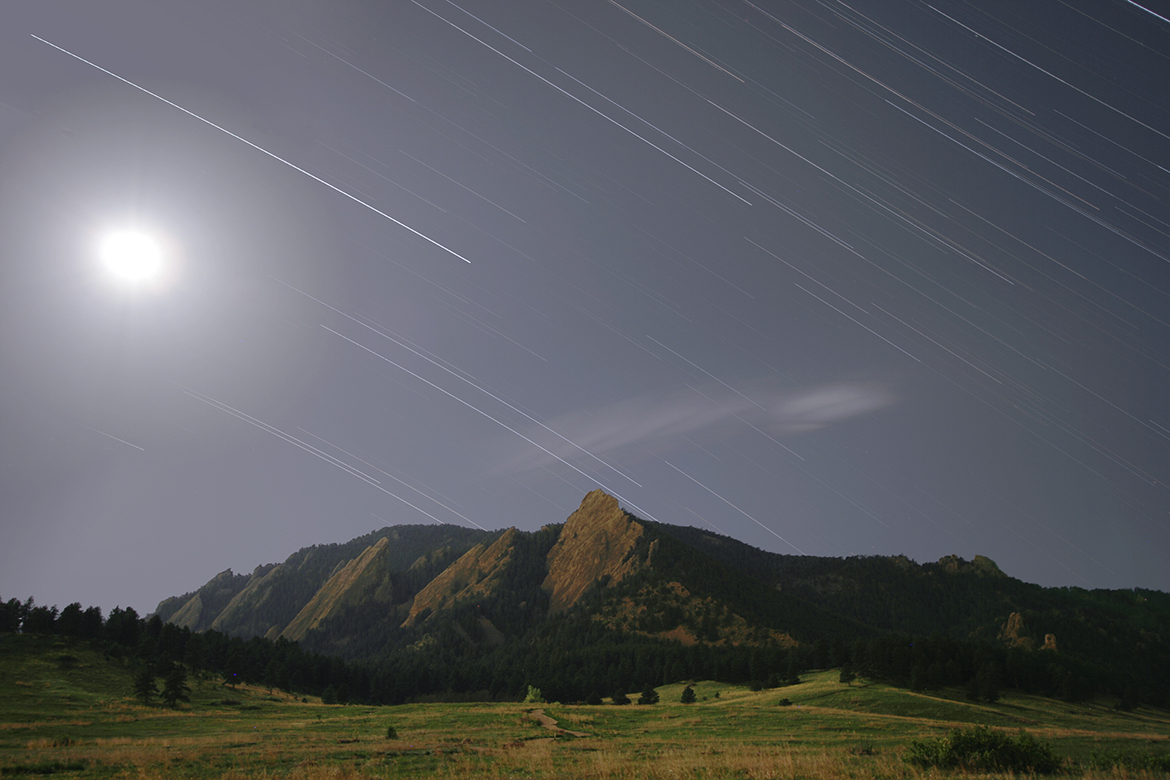
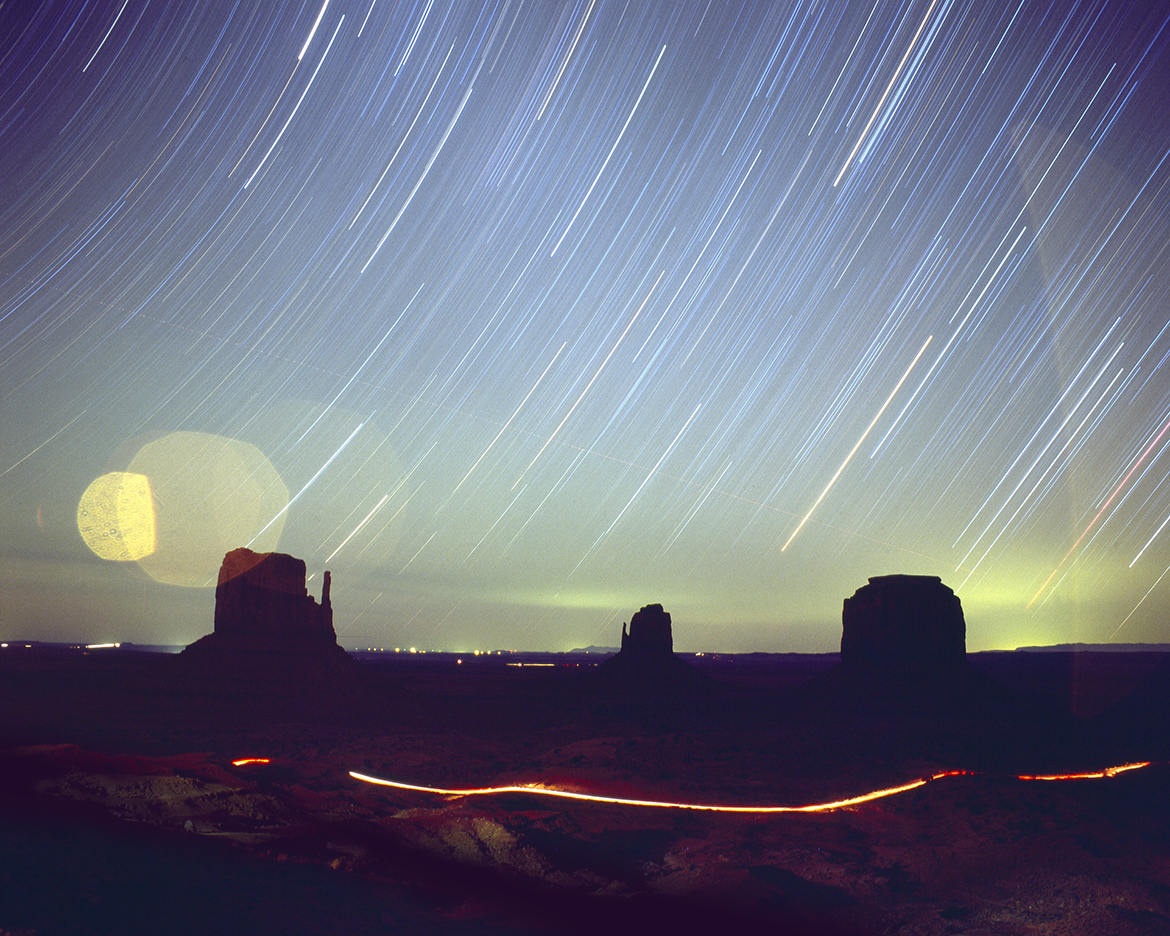
This is an early experiment in taking star trail photos with a digital camera. Ninety exposures of 1-minute each were composited with the “lighten” blending mode in Photoshop. During this elapsed time, the moon entered the frame. It has been dodged out except for its position in the final exposure.
I had traveled to Boulder Colorado frequently, where this section of the Rocky Mountain’s front range offers protection and beauty to the CU campus. In all of my prior trips, the days were sunny and clear, but when the sun set, the mountains pulled a blanket of clouds over themselves.
Not so on this day, the day I had come to see my son graduate. A few wisps of moisture drifted across the peaks, but the sky stayed open, and the full moon illuminated the slabs of the flatirons with its distinctive diffuse light.
In the high resolution copy of this image, the individual exposures are discerned. Each was actually 55 seconds long, separated from the next by 5 seconds. This is too long a delay, the gaps between the star trail segments is visible. At lower resolution, the segments merge together to form the classic pattern of stars apparently streaming across the sky.
A 90-minute exposure captures a variety of lights. The stars mark their clockwork passage across the sky of course, but civilization also leaves its mark. Airplane beacons flash as they pass through, distant towns show on the horizon, and local traffic finds its way along the private road below. Private, but not unseen, and when the headlights aim in my direction, with the lens wide open, the film captures their flare.
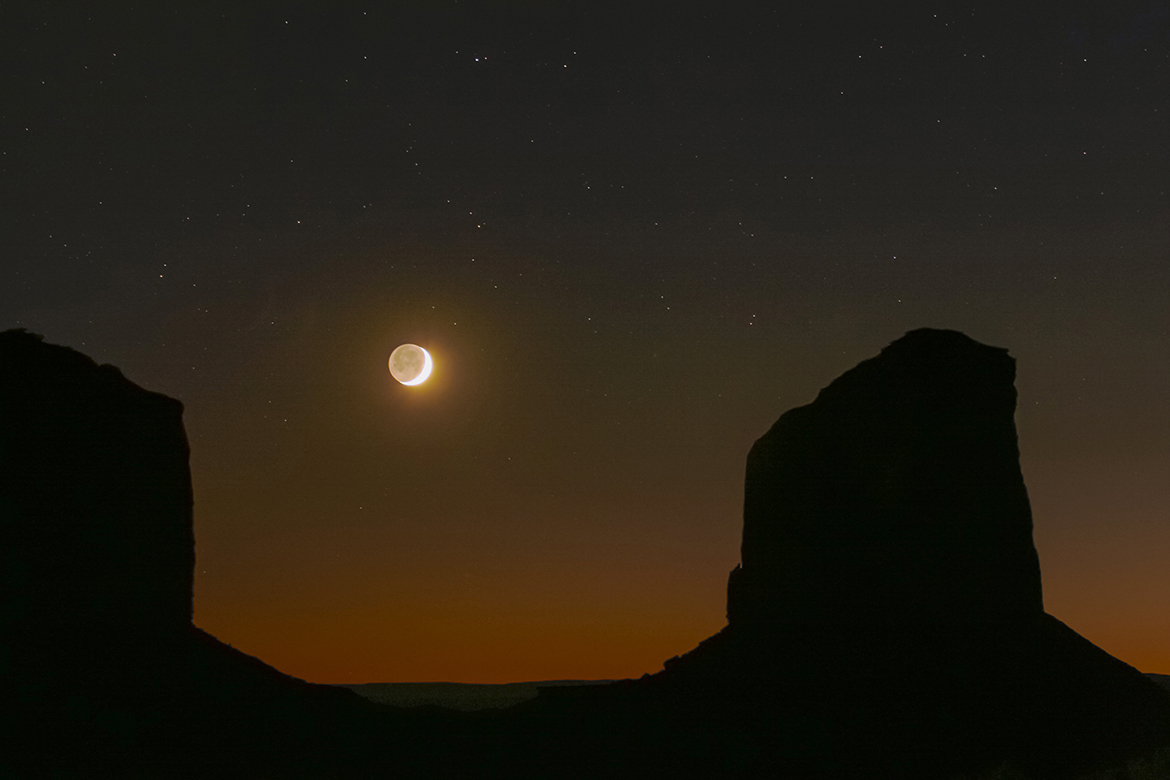
As the sun sets in the west, the view to the east shows a distinct purplish band at the horizon. This is the Earth’s shadow on the sky, a forecast of the twilight to come.
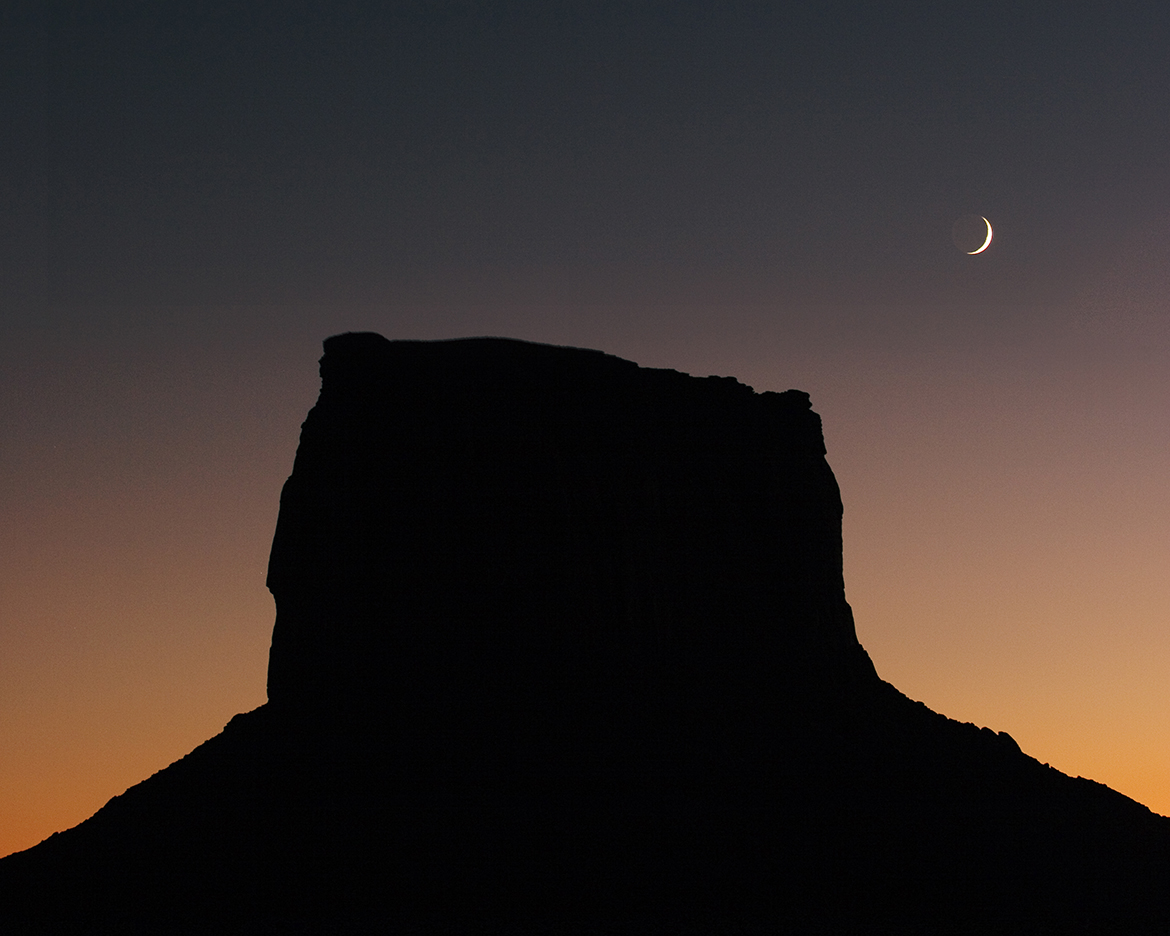
The sun has just set and the remaining colors cast a warm glow on the “North Mitten”. The sky behind it shows the shadow of the Earth on the sky just above the horizon.
I have used this blog as a vehicle to “pre-publish” the pages for what I call “Coffee Table Nightscapes”. I’ve been reviewing the night sky pictures and astrophotos that I have taken over the last few decades, selecting my favorites, annotating them, and preparing them to be published as a photo book. They begin with pictures of comet Hale-Bopp in 1997, include many from my Nightscape Odyssey taken in 2001, and I had worked my way up through the 2004 pictures from Yosemite.
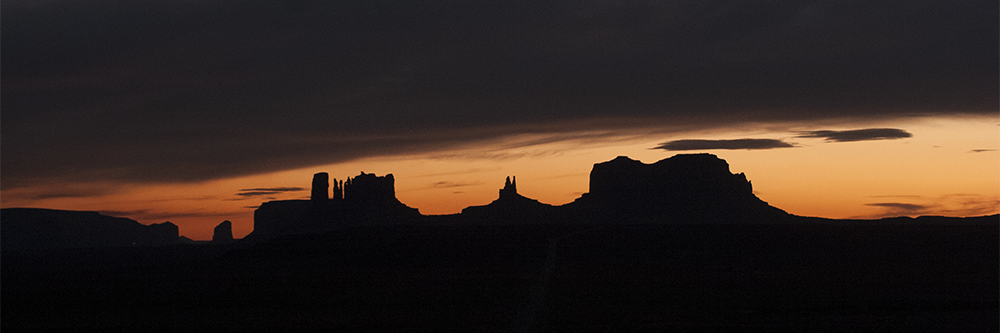
I will now pick up from there by posting pictures of Monument Valley during a trip to Arizona in 2005. The full story of obtaining these photos has already been presented in earlier blog entries. Here is a portrait of the distinctive landscape at sunset, one I have included among the banner images on this site.
As I approached the Navaho Nation, the sun set and I was able to take this photo of Monument Valley from afar, silhouetted by the glowing sky
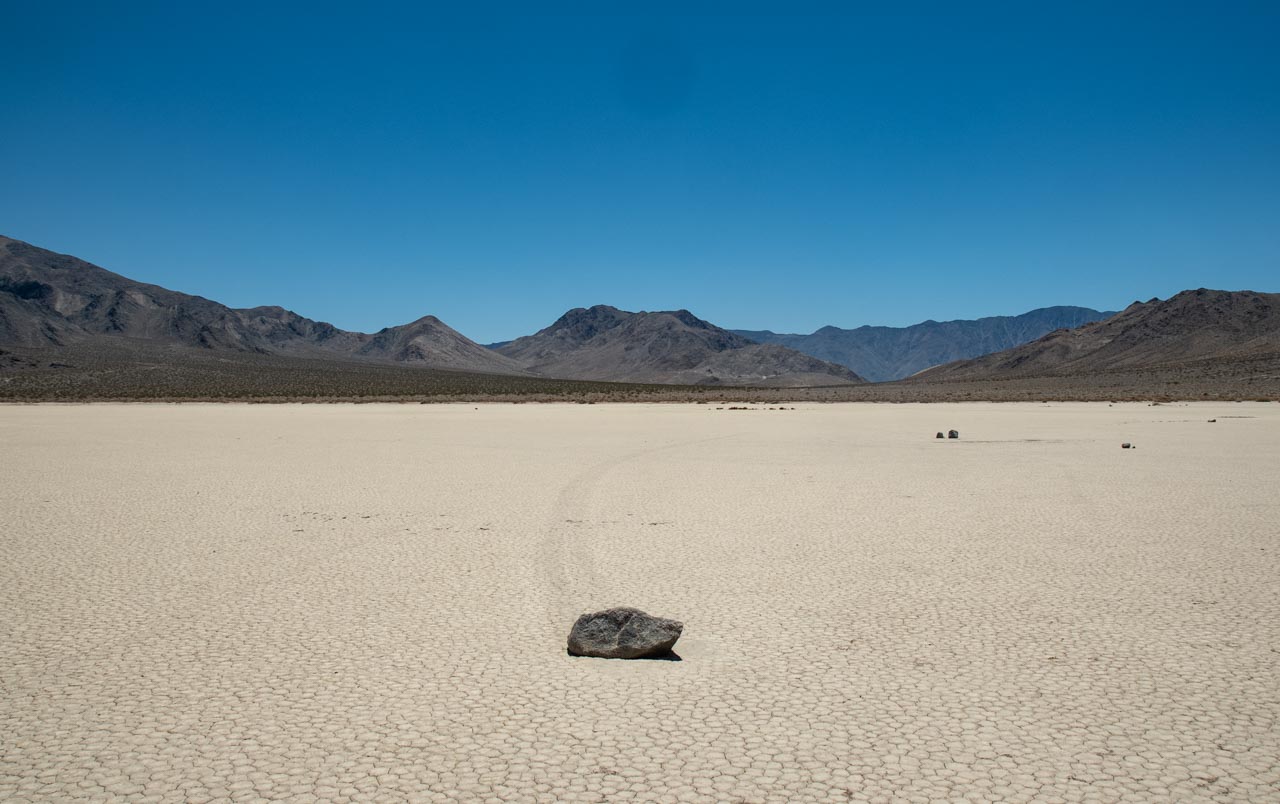
A sailing stone, the path behind it showing the route it took to get here.
There was a second wide spot in the road at the south end of the playa; we parked and continued our explorations. This time we found stones sitting on the surface of the lakebed. There were not many, and we had to hike a mile or so to find them. Some sat happily contemplating their position in the uniform semi-infinite plane of mud cracks. Others showed a faint trail of disturbed, and now solidified mud, leading to their current position. These were the famous sailing stones!