I have been a photographer longer than a programmer–if I really ever was that. I took my first pictures before the age of 8. So I have a similar experience of adapting to new ways in both technical fields in my terza eta.
Last month I attended the Nightscaper Photo Conference in Farmington, New Mexico. I had discovered this group of avid night sky photographers five years ago and attended their 2021 conference. Attendance back then was diminished by the impact of Covid, but the enthusiasm of the presenters was not. Now, in 2026, I was pleased to be among the over 200 attendees, and to learn from presenters with even greater enthusiasm for this odd activity.
It was an inspiring experience, but as I listened to the techniques and tools described by these intrepid photographers, I realized that this specialized hobby that I have pursued since before the turn of the century had completely changed. I am partly responsible, having contributed to the transition from film to digital photography, but I did not anticipate the dramatic flourishing of creative work that has resulted.
Modern photographers use methods that were unavailable or extremely difficult before the advent of digital cameras. Among them is the ability to seamlessly combine multiple images into a single photograph. The term composite is used to describe the picture that results from combining any two or more images in some creative way. There are no rules; it can be any mashup of scenes to meet any artistic goal.
Cutting and pasting a subject into a lunar landscape is an example of a composite. An early tool to do this was Adobe Photoshop. With our common linguistic practice of verbizing nouns, we now have the term “Photoshopping” to describe the making of fictitious or synthetic scenes.
Because digital compositing can easily create any such pictures, it is often used to deceive the viewer. But there is a special case of compositing that has a different goal. When the individual images are taken by the same camera through the same lens, looking at the same subject, it is called a “blend”. The purpose is not to deceive, but to better represent the appearance and feeling of the scene by combining pictures taken at different moments.
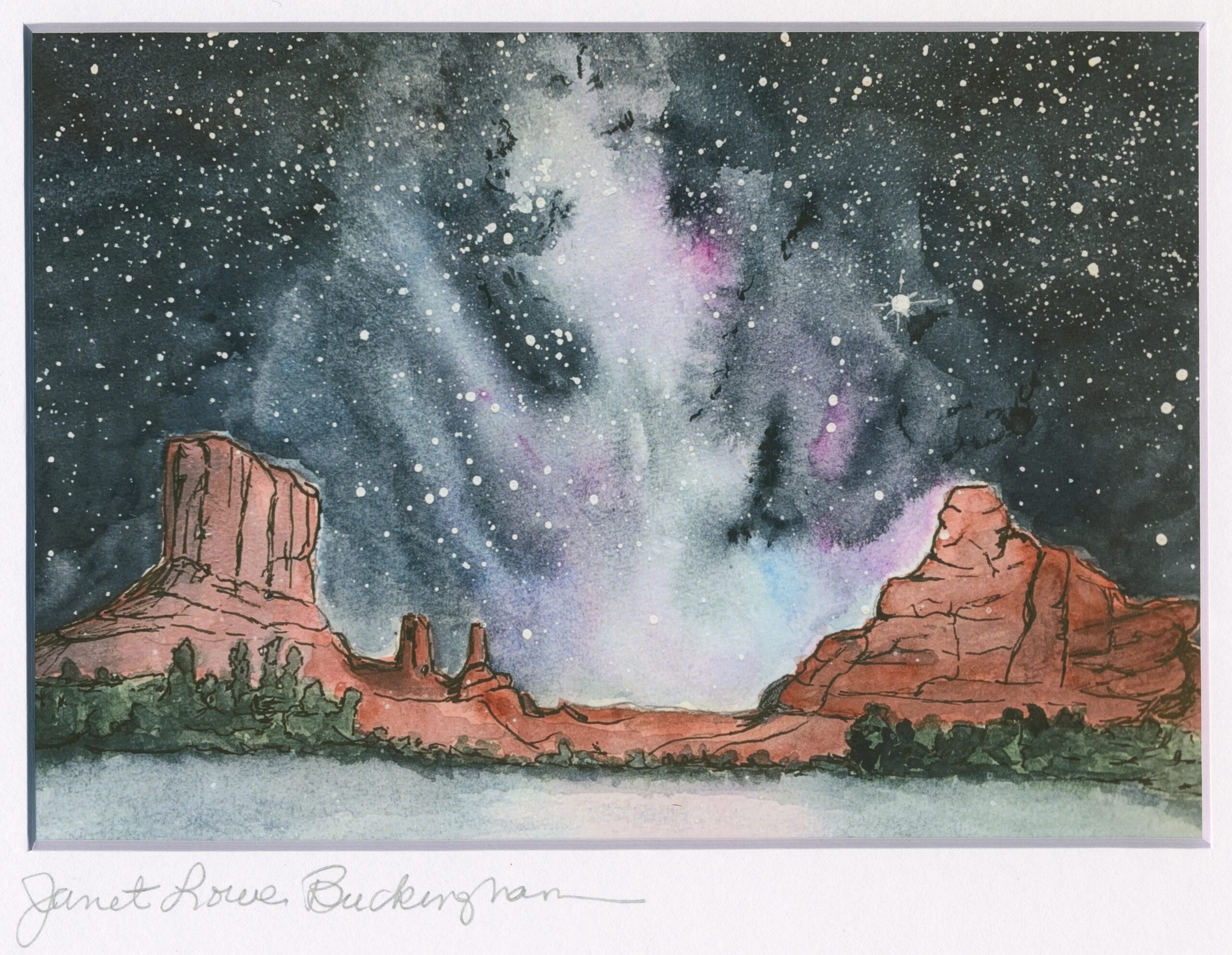
An artist’s rendition of our night photography location in Castle Valley near Moab Utah.
Taking pictures of the night sky has always been a solo enterprise for me. There are few friends or partners willing to endure the long hours of dark cold nights. I do not blame them; it is a crazy activity that few others share. The closest I’ve found is our local astronomy club which hosts star parties to observe celestial objects, that can last all night.
But there are a few others as well: landscape photographers who are looking to present more of the night than a view through a telescope. They want to show the full scene, land and sky, and depict the magic feeling one has while viewing it at night.
I was thrilled to learn about the Nightscaper Photo Conference. I had no idea that there were so many others out there doing what I have been doing. Enough that it makes sense to bring them together at a conference where they share their techniques and their images to educate and inspire each other.
I also learned that this community offers night photo workshops, where an instructor or two take small groups to photogenic dark sky locations and spend several nights shooting. I would normally never join such a group, but after realizing that my superpowers for this activity were fading, and wanting to remain safe in the remote locations I like to visit, I decided to subscribe to one. I signed up for the Moab, Utah workshop hosted by a small company of nightscaper photographers, “National Parks at Night”.
I wasn’t sure how it would go. Having done this on my own all these years and resenting any intrusion by other humans into my scene space, I thought we might get in each other’s way. This turned out to be not a problem, because these humans were all cooperative, and considerate. All of us were after the same thing, and there was plenty of room to spread out and do it. Yes, there were occasional unintentional light trespasses, but they were always forgiven. A small cost for the comfort of being in a supportive group.
I will have more to say about my workshop experience. But for now, I want to convey that it was a great success—I was able to take pictures from wonderful sites, enjoy the safety and security of being in a group, and to get one of my best shots of the Milky Way ever!
Not every night was ideal. Clouds persisted the first night, and haze intruded the third. But this is part of the mystique. We can place ourselves at the right time and location, but the weather will be what it will be. It can be disappointing and discouraging, but I encountered a new way of thinking about this at the conference. Ken Lee, who presented a strategy for maintaining a photographer’s creative spark, advised us to pack the gear and just go out. It might not result in that next great shot; you might not even unload the gear, but “you have already won!” You are out under the night skies, taking it in. Enjoy it, savor it. Anything more is bonus material.
On the nights of the workshop, as the twilight faded to reveal a canopy of stars and as we anticipated the rising of the Milky Way, and even before I had taken my first exposures, I thought, “I have already won!” And that is the feeling I’d like to capture in my pictures.
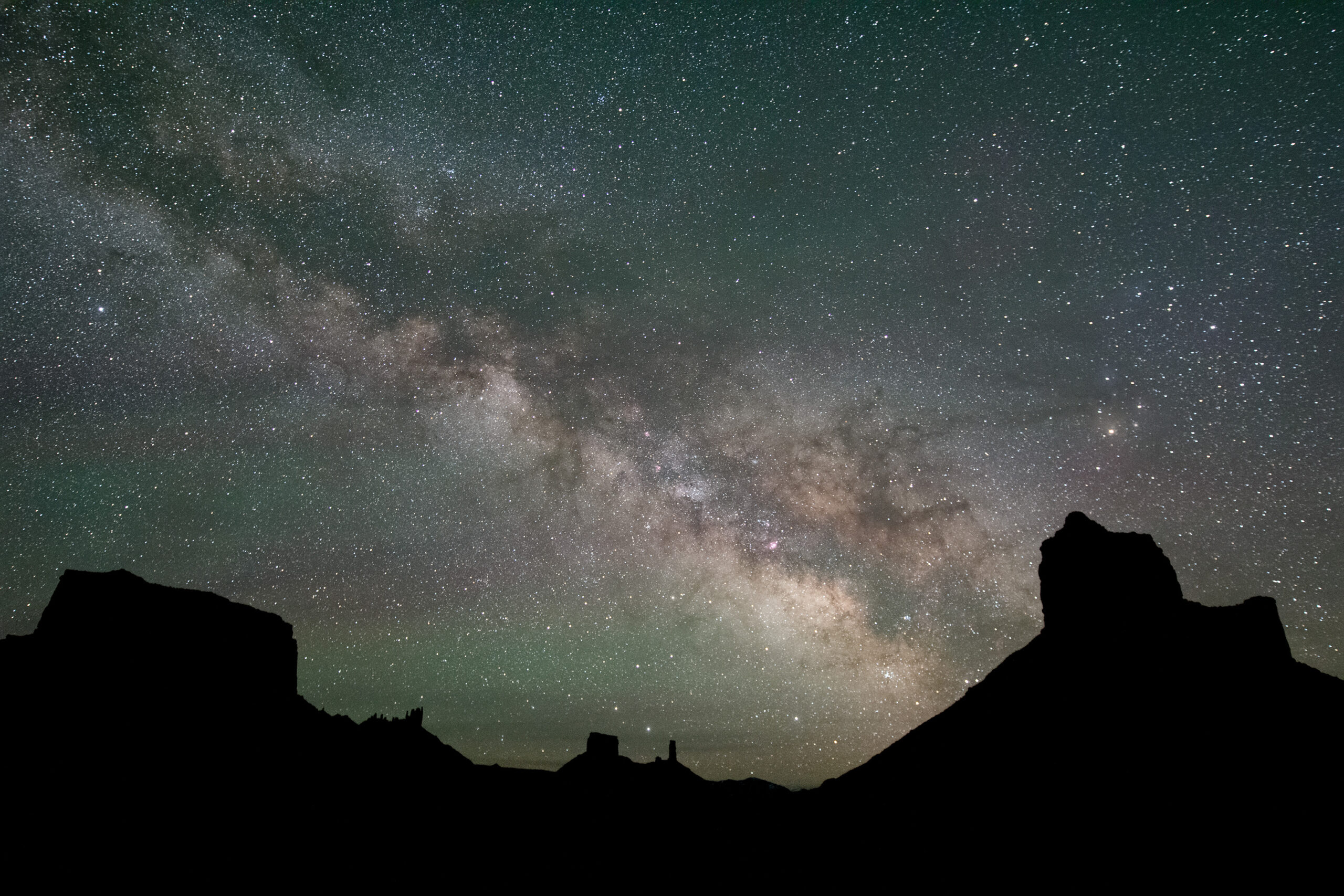
I will eventually create a timelapse, but here is a frame from my exposures that night.
Near Ida Gulch, Castle Valley, Moab Utah. Click to enlarge (it’s worth it).